
The DeepSeek Moment: What AI Cost Drops Mean for Retail
Introduction: The Day the Rules Changed
On January 27, 2025, something unprecedented happened in financial markets. Nvidia, the company that had become synonymous with AI infrastructure, lost nearly $600 billion in market value in a single trading session — the largest one-day loss for any company in U.S. history. Microsoft and Google shares dropped sharply. The entire AI infrastructure investment thesis seemed suddenly vulnerable.
The catalyst: a Chinese AI startup called DeepSeek had released a language model matching GPT-4’s performance. The development cost? Approximately $5.6 million. For comparison, OpenAI spent around $100 million developing GPT-4. DeepSeek achieved comparable results at roughly 5% of the cost.
Wall Street’s reaction focused on infrastructure implications — the assumption that building frontier AI required massive capital investment had been challenged. But for retail executives, the DeepSeek moment carried different implications entirely.
The financial barrier to AI capabilities had just collapsed. Technologies that required enterprise-scale budgets six months earlier were suddenly accessible to any mid-market retailer willing to implement them. The question changed overnight: not “can we afford AI?” but “can we afford to compete without it?”
This guide examines what the AI cost collapse means for retail operations, where the opportunities lie, and how e-commerce leaders should respond to what may be the most significant shift in competitive dynamics since the mobile commerce revolution.
Part One: Understanding the Cost Collapse
The Speed of Change
The numbers are almost difficult to process. LLM inference costs have declined faster than nearly any computing commodity in history.
According to multiple analyses tracking AI pricing trends, inference costs have fallen 10x annually on average, with some task categories showing 900x declines over three-year periods. The rate varies by benchmark — basic tasks show 9x annual decline while frontier capabilities have seen reductions approaching 900x — but the direction is consistent and accelerating.
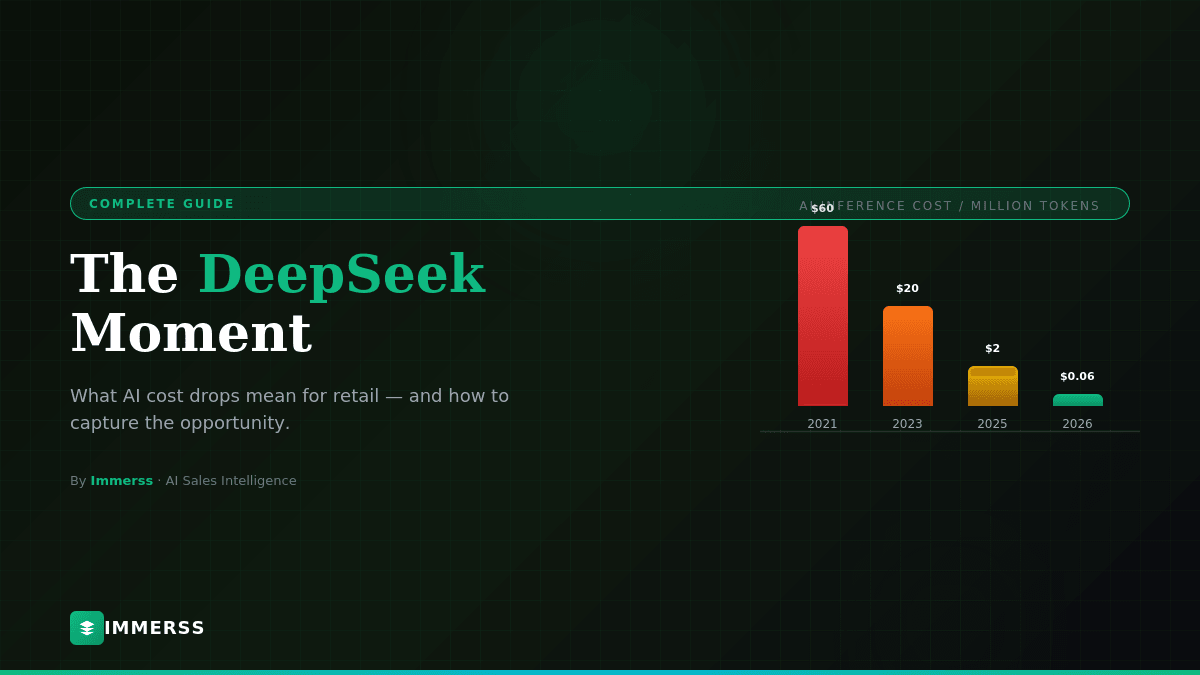
To put this in concrete terms: when GPT-3 became publicly accessible in late 2021, it was the only model achieving basic benchmark performance. The cost was approximately $60 per million tokens. By early 2026, multiple models exceed that benchmark at $0.06 per million tokens or less. That’s a 1,000x reduction in just over three years.
For comparison, this cost reduction curve is steeper than PC compute during the microprocessor revolution. Steeper than bandwidth during the dotcom boom. AI is becoming cheaper faster than any previous technology adoption cycle in modern history.
What DeepSeek Actually Demonstrated
DeepSeek’s innovation wasn’t a single breakthrough but a combination of architectural and engineering optimizations that dramatically reduced both training and inference costs.
The company’s mixture-of-experts (MoE) architecture activates only 37 billion out of 671 billion parameters for processing each token, reducing computational overhead without sacrificing performance. Optimized distillation techniques allow reasoning capabilities from larger models to transfer to smaller ones. Multi-head latent attention mechanisms reduce memory usage to 5-13% of previous methods.
Beyond model architecture, DeepSeek improved hardware utilization through memory compression, load balancing, and using PTX programming instead of CUDA for better control over GPU instruction execution.
The result: comparable performance to frontier U.S. models at 3-5% of the inference cost. DeepSeek claims a theoretical 545% cost-profit ratio on their inference operations — meaning they could theoretically earn $5.45 for every dollar spent on compute.
While the exact numbers are difficult to verify independently, the directional reality is clear: DeepSeek demonstrated that building and running frontier AI doesn’t require the capital intensity the industry had assumed.
The Broader Cost Trend
DeepSeek accelerated an existing trend rather than creating it. The cost collapse was coming regardless — DeepSeek just made it happen faster and more visibly.
Gartner projects that by 2030, performing inference on a trillion-parameter model will cost GenAI providers over 90% less than it did in 2025. The drivers include semiconductor efficiency improvements, model design innovations, higher chip utilization, increased use of inference-specialized silicon, and application of edge devices for specific use cases.
Current cloud GPU pricing reflects this trajectory. H100 instances that launched above $7 per hour on AWS in 2023 are now available under $2.50 per hour on specialist providers. A100s are approaching commodity pricing below $1 per hour.
The implication for retail: AI capabilities that seemed expensive yesterday will seem trivially cheap tomorrow. Planning around current costs means underestimating future possibilities.
Part Two: Implications for Retail
The Affordability Threshold Crossed
Eighteen months ago, deploying AI-powered customer engagement at scale required significant infrastructure investment, specialized talent, and ongoing operational costs that placed such capabilities firmly in enterprise territory.
A mid-market retailer considering AI sales agents faced implementation costs requiring extensive ROI justification and multi-year payback calculations. The analysis typically concluded that AI made sense for large retailers with sufficient transaction volume to justify the investment, but remained questionable for smaller operations.
The cost collapse changes this calculation fundamentally. At current cost structures, the same capabilities that required careful ROI analysis now show almost trivially positive returns.
Consider the benchmark data on AI engagement effectiveness:
- AI-engaged visitors convert at a dramatically higher rate than self-serve browsers
- Proactive AI chatbots recover a meaningful share of abandoned carts
- Shoppers complete purchases markedly faster when assisted by AI tools
- Companies using AI personalization earn 40% more revenue than those without
- AI-powered sales generate 64% of revenue from first-time shoppers
At previous cost structures, achieving these results required substantial investment. At current cost structures, the investment required has dropped by 90% or more while the benefits remain constant.
The barrier isn’t financial anymore — it’s implementation velocity.
The Democratization Effect
The most significant implication isn’t about large retailers gaining efficiency. It’s about mid-market and smaller retailers gaining capabilities they couldn’t previously access.
The adoption data tells this story clearly. Close to 60% of small businesses are now using AI, up 18% year-over-year in 2025 and double the amount since 2023. Among SMBs with AI implementation, 87% report it helps scale their operations. As of 2024, 75% of small and medium-sized businesses are at least experimenting with AI tools.
This democratization matters because it changes competitive dynamics fundamentally.
Previously, enterprise retailers held structural advantages in customer experience. They could afford the personalization engines, the recommendation systems, the 24/7 customer engagement capabilities that smaller competitors couldn’t match. A regional jeweler couldn’t offer the same shopping experience as a national chain. A specialty fashion boutique couldn’t compete with the recommendation sophistication of luxury department stores.
The cost collapse erases much of that advantage. The underlying AI capabilities are now accessible to any retailer willing to implement them. A regional jeweler can deploy AI sales agents with the same underlying technology as national chains. A specialty retailer can offer personalized recommendations comparable to enterprises with hundred-person data science teams.
DeepSeek’s open-source approach accelerated this dynamic further. The models can be downloaded, modified, and deployed without licensing fees. U.S.-based enterprises can audit the code, customize the implementation, and run entirely on domestic infrastructure if desired.
The barriers aren’t gone entirely — implementation still requires expertise, and configuration for retail-specific use cases matters enormously. But the financial barrier that kept AI capabilities concentrated among large enterprises has largely disappeared.
From Infrastructure Race to Application Race
The DeepSeek moment also signaled a broader shift in where AI value creation happens.
For years, the AI industry operated on an assumption that competitive advantage came from infrastructure scale. More compute, more data, more training investment. The companies with the largest GPU clusters and the deepest pockets would build the best models and capture the most value.
DeepSeek demonstrated that architectural innovation and training efficiency can produce comparable results at dramatically lower cost. The implication: the infrastructure race matters less than the application race.
As one analysis put it: “What you can build with AI becomes more important than how much compute you can assemble to build it.”
For retail, this shift is liberating. Retailers aren’t in the business of building foundation models — they’re in the business of selling products and serving customers. The relevant question was never “can we train better AI?” but “can we deploy AI effectively in retail contexts?”
As model capabilities commoditize and costs collapse, the differentiation moves to implementation: how well you configure AI for your specific products, how effectively you integrate it into customer journeys, how intelligently you combine AI assistance with human expertise for complex purchases.
This is terrain where retailers can compete — and where retail-specific AI platforms have structural advantages over general-purpose models that lack deep understanding of commerce contexts.
Part Three: The Consumer Expectation Shift
Adoption Acceleration
Cost reduction at the provider level translates to capability expansion at the consumer experience level. As AI becomes cheaper to deploy, more retailers deploy it. As more retailers deploy it, consumer expectations adjust.
The adoption acceleration data is striking:
- AI-driven U.S. e-commerce traffic grew 758% year-over-year between November 1 and December 1, 2025
- AI traffic to U.S. retail sites on Cyber Monday 2024 increased 1,950% year-over-year
- Traffic from generative AI sources to retail sites increased 4,700% year-over-year
- During the 2025 holiday season, AI was credited with driving 20% of all retail sales
- AI engagement generated $262 billion in holiday revenue through personalized recommendations
Shoppers arriving from AI sources behave differently once they land: they stay longer, bounce less, and go deeper into the catalogue. That follows from how they got there — an assistant has already narrowed the field, so they arrive with a shortlist rather than a category.
The Expectation Gap
Consumers are adapting to AI-assisted shopping faster than many retailers are adapting to provide it.
Morgan Stanley predicts that nearly half of online shoppers will use AI shopping agents by 2030, accounting for approximately 25% of their spending. The behavioral shift isn’t hypothetical — it’s already underway, and accelerating.
This creates an expectation gap that represents competitive vulnerability. Retailers without AI engagement capabilities increasingly feel outdated compared to those offering sophisticated AI assistance. The experience gap becomes a conversion gap becomes a market share gap.
The pattern resembles previous technology transitions. When mobile commerce emerged, early mobile-optimized retailers captured disproportionate share as consumer behavior shifted. When social commerce emerged, brands with strong social presence captured attention that others couldn’t access. AI-assisted commerce follows the same pattern — the retailers who meet evolving expectations capture value while those who lag lose relevance.
The Agentic Commerce Horizon
Looking slightly further ahead, the cost collapse enables a transition from AI-assisted commerce to agentic commerce — where AI agents act autonomously on behalf of consumers, comparing products, applying rewards, completing purchases without human intervention at each step.
Major retailers are already positioning for this shift. Walmart, Target, Etsy, and others have partnered with OpenAI, Google, and other AI platforms to make products available within AI interfaces. Amazon’s Rufus assistant now includes “Auto Buy” functionality that completes purchases when products reach target prices.
The growth in AI-referred traffic, whatever multiple you put on it, points one way. Retailers who are discoverable and purchasable through AI interfaces will capture that traffic; those who aren’t become invisible to a segment that is no longer small.
Part Four: Strategic Implications
The Inverted ROI Calculation
The DeepSeek moment inverted a calculation that had governed retail AI investment for years.
Previously, the question was: “Do the benefits of AI justify the investment required?” The analysis carefully weighed implementation costs against projected conversion improvements, cart recovery rates, and operational efficiencies. Many retailers concluded the investment wasn’t justified given their scale.
Now, the question is: “What’s the cost of NOT having AI capabilities?” The calculation isn’t about whether AI pays for itself — at current cost structures, it clearly does. The calculation is about competitive disadvantage from operating without capabilities that customers increasingly expect and competitors increasingly provide.
The conversion gap between AI-engaged and self-serve visitors represents real revenue left on the table. The cart recovery from proactive AI represents purchases that could have been captured. The markedly faster purchase completion represents friction that didn’t need to exist.
At previous cost levels, accepting these gaps might have been rational given budget constraints. At current cost levels, accepting them is simply leaving money on the table.
Implementation as the Primary Challenge
With the financial barrier largely removed, implementation becomes the primary challenge. Deploying AI effectively in retail contexts requires more than plugging in a language model.
Configuration matters enormously. The difference between AI that supports sales and AI that deflects customers to FAQs comes down to how the system is designed and trained. Generic chatbot implementations produce generic results — roughly baseline conversion. Retail-optimized AI sales agents configured for sales outcomes produce the dramatically higher conversion rates that create competitive advantage.
The distinction parallels the support-versus-sales orientation we’ve discussed in other contexts. AI configured for cost reduction (deflect inquiries, minimize human involvement, close tickets) produces fundamentally different results than AI configured for revenue generation (engage proactively, guide purchase decisions, overcome objections, close sales).
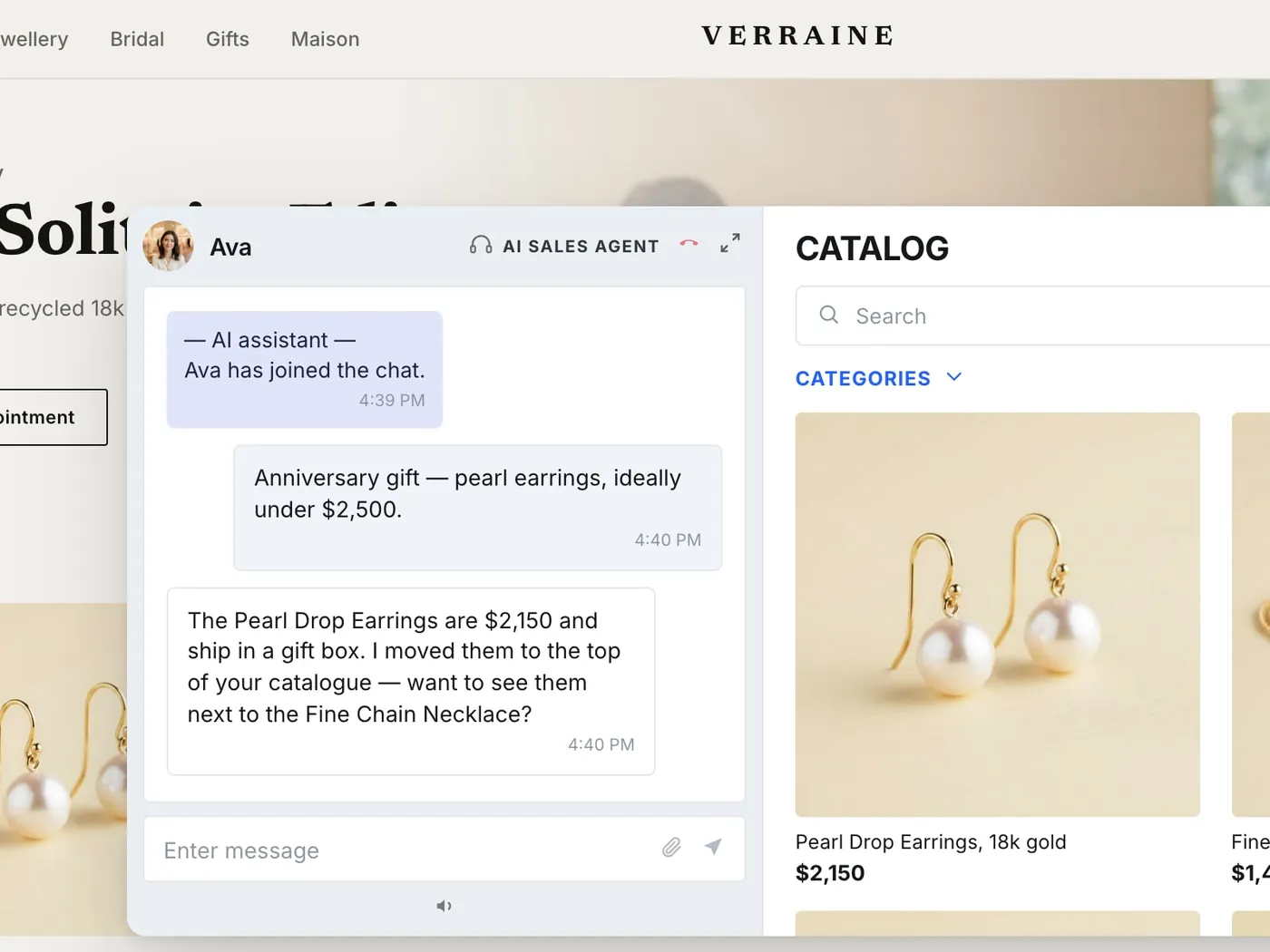
Integration matters. AI engagement needs to connect with product catalogs, inventory systems, CRM data, and checkout processes. Standalone AI that can’t access product information or complete transactions provides limited value compared to deeply integrated systems that guide customers through complete purchase journeys.
The difference between AI that says “I recommend this product” and AI that can show the product, check availability, apply promotions, and guide checkout is the difference between a novelty and a sales channel.
Human-AI coordination matters. The most effective implementations combine AI efficiency with human expertise. AI handles routine inquiries, qualifies opportunities, and manages volume. Human sales associates engage on complex purchases, build relationships, and provide the nuanced guidance that creates lasting customer loyalty.
The goal isn’t replacing human sales capability with AI — it’s extending human capability through AI, allowing your best people to focus on high-value interactions while AI handles everything else.
The Implementation Window
The DeepSeek moment created a window of opportunity. AI capabilities that were previously inaccessible are now affordable. Consumer expectations are shifting toward AI-assisted experiences. The retailers who implement effectively during this window build competitive advantages that compound over time.
Customer relationships formed through AI engagement become retention advantages. Operational learnings from AI deployment become efficiency advantages. Market position established while competitors deliberate becomes share that late movers struggle to recapture.
The window won’t stay open indefinitely. As more retailers deploy AI, baseline expectations rise. What feels like competitive advantage today becomes table stakes tomorrow. The opportunity isn’t to eventually implement AI — it’s to implement it now, while the gap between AI-equipped and AI-absent retailers still represents meaningful differentiation.
Part Five: Navigating the Transition
What to Prioritize
Not all AI implementations create equal value. Given limited implementation bandwidth, retailers should prioritize based on impact and feasibility.
Highest priority: AI-powered sales engagement. The conversion gap between AI-engaged and self-serve shoppers represents the largest available opportunity for most retailers. AI sales agents that engage customers proactively, guide product selection, answer questions, and facilitate checkout create direct, measurable revenue impact. This should be the first AI capability most retailers deploy.
Second priority: cart abandonment recovery. The meaningful recovery rate from proactive AI intervention represents substantial revenue from customers who already demonstrated purchase intent. Recovery workflows are relatively straightforward to implement and show clear ROI.
Third priority: personalization and recommendations. Product recommendations drive up to 31% of e-commerce site revenues for mature implementations. AI-powered personalization creates relevant experiences that increase both conversion and average order value.
Fourth priority: customer service augmentation. While less directly revenue-generating, AI-assisted service improves satisfaction, reduces wait times, and frees human agents for complex issues. The 93% of customer questions resolved by AI without human intervention represents significant operational efficiency.
What to Avoid
Some AI implementations sound appealing but create limited value or active harm.
Avoid AI for cost reduction at the expense of customer experience. Chatbots designed primarily to deflect inquiries and minimize human involvement may reduce costs but also reduce conversions. The goal is revenue generation, not ticket closure.
Avoid generic implementations without retail configuration. General-purpose AI models lack understanding of product catalogs, pricing, promotions, inventory, and purchase contexts. Retail-specific configuration is essential for meaningful results.
Avoid replacing human expertise entirely for high-consideration purchases. Luxury items, complex products, and relationship-dependent categories still benefit from human engagement. AI should extend human capability, not replace it.
Avoid implementations that don’t integrate with existing systems. Standalone AI that can’t access product data, customer history, or checkout creates fragmented experiences that frustrate rather than assist.
Evaluation Framework
When evaluating AI implementation options, consider:
Sales orientation vs. support orientation. Is the system designed to generate revenue or reduce costs? The distinction matters enormously for outcomes.
Integration depth. Can the AI access product information, inventory data, customer history, and checkout processes? Deeper integration enables more valuable interactions.
Configuration flexibility. Can the implementation be customized for your specific products, brand voice, and sales processes? Generic configurations produce generic results.
Human handoff capability. Can the AI seamlessly transition complex situations to human sales associates? The best implementations know their limits.
Measurement and optimization. Does the platform provide visibility into performance and enable ongoing optimization? AI effectiveness improves dramatically with proper measurement and iteration.
Conclusion: The Rules Have Changed
The DeepSeek moment wasn’t just a news story about a Chinese AI startup. It was a signal that the rules of retail competition had changed permanently.
For years, AI capabilities existed behind a financial barrier that limited access to well-funded enterprises. That barrier has collapsed. The same technologies that required enterprise-scale investment now cost a fraction of previous estimates. The same capabilities that created competitive advantage for large retailers are now accessible to any business willing to implement them.
The implications ripple through every aspect of e-commerce competition:
Customer expectations have shifted. Consumers increasingly expect AI-assisted shopping experiences. Retailers without such capabilities feel increasingly dated by comparison.
Competitive dynamics have changed. The technology gap between large and small retailers is narrowing. Mid-market retailers can now deploy capabilities that match enterprise offerings.
The ROI calculation has inverted. The question isn’t whether AI pays for itself — it clearly does. The question is what you’re losing by not having it.
Implementation velocity matters more than implementation investment. The barrier isn’t financial — it’s execution speed. First movers build advantages that compound.
The DeepSeek moment removed the cost barrier. The implementation barrier remains, but it’s solvable. The retailers who recognized the moment for what it was — a fundamental shift in competitive dynamics — and moved quickly to implement AI capabilities will capture disproportionate value from the transition.
The question isn’t whether AI will transform retail customer engagement. That transformation is already underway, accelerating faster than most industry observers predicted.
The question is whether your store will be leading the transition or scrambling to catch up.