
Sales-First vs Support-First: A Playbook for Choosing AI That Actually Converts
Most stores that are disappointed by their “chatbot” made one decision wrong at the very start: they bought a support-first tool and expected sales-first results. The two look identical — a conversation window on your site — but they’re built to optimize opposite outcomes. This playbook helps you tell them apart, choose correctly, and deploy the one that moves conversion and AOV instead of just cutting support costs.
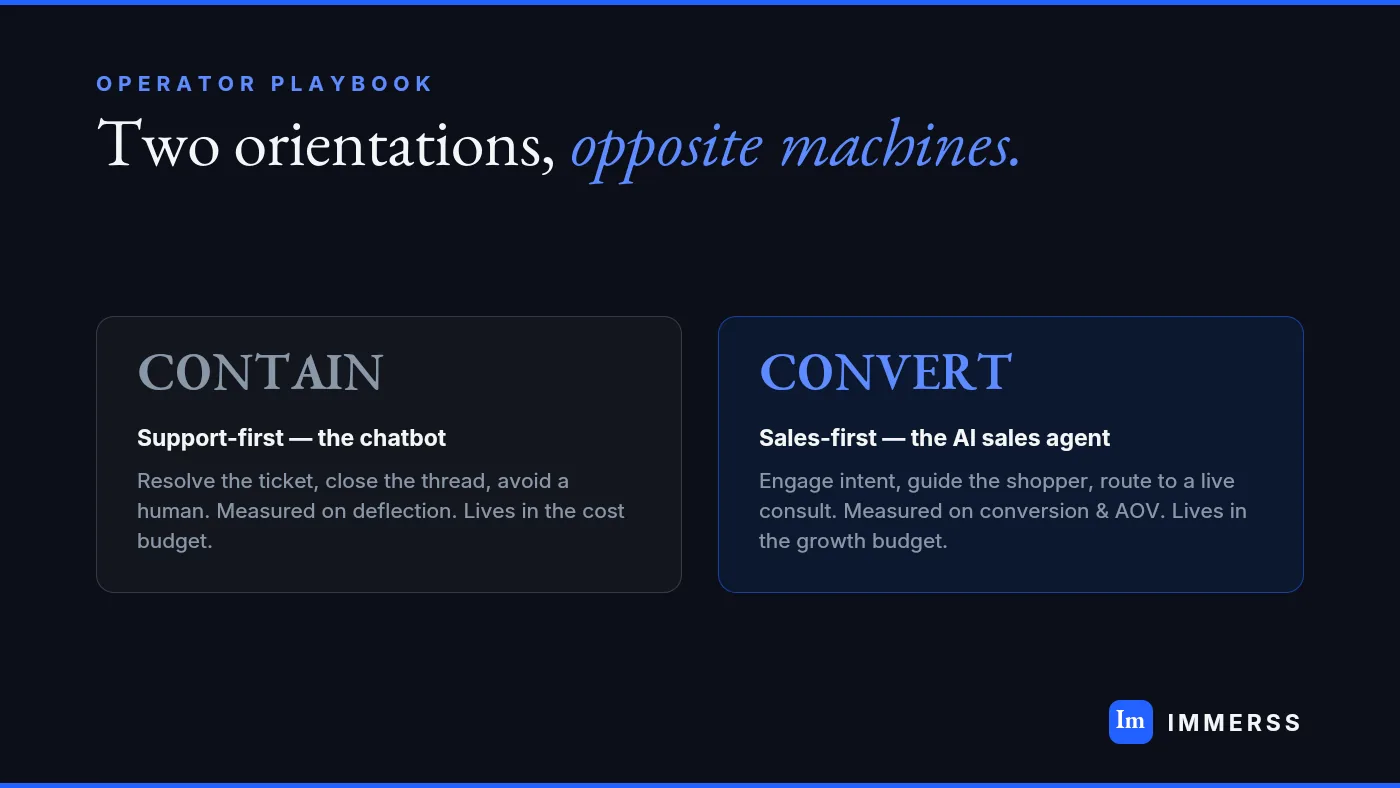
The two orientations are opposite machines
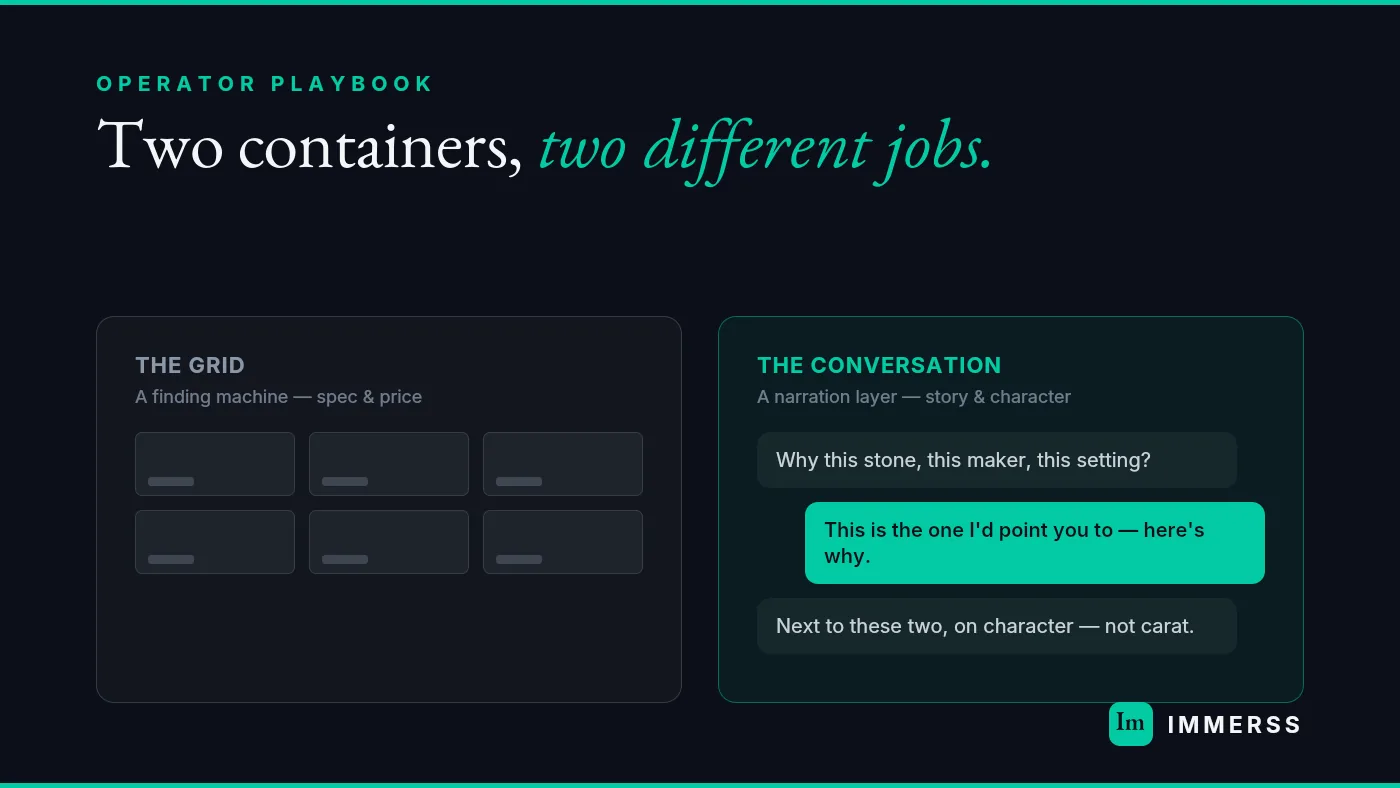
A chatbot is built to end conversations — resolve the ticket, contain the cost, avoid a human. An AI sales agent is built to open them — engage intent, guide the shopper, close a sale. That single difference cascades into everything:
| Support-first (chatbot) | Sales-first (AI sales agent) | |
|---|---|---|
| Goal | Resolve & deflect | Guide & convert |
| Posture | Reactive — waits | Proactive — engages at intent |
| Trained on | FAQs, policies | Live catalog, inventory, behavior |
| Reflex when unsure | Close the loop | Lean in, keep going |
| Success metric | Containment, deflection | Conversion, AOV, revenue |
| Lives in | Support budget (cost) | Growth budget (revenue) |
| Handing off to a human is… | A failure (escalation) | The strategy (consultation) |
If your current tool sits on the left, no amount of tuning moves it right. Orientation isn’t a setting — it’s the architecture.
How to tell which one a vendor is selling you
Don’t read the feature list. Apply these three tests:
- The metric test. Ask what it reports. Containment and deflection rates = support-first. Conversion and AOV = sales-first.
- The budget test. Ask which budget it’s justified from. “Cut support costs” = chatbot. “Grow revenue” = sales agent.
- The handoff test. Ask what happens with a high-value, hesitant shopper. “It resolves it without a human” = support-first. “It routes them to a live consultation” = sales-first.
A tool that can only prove cost savings is telling you, plainly, which machine it is — whatever the label says.
The ICP filter — is a sales-first agent right for you?
Run this against your store:
- Shopify Plus, 50K+ monthly visits, AOV $100+ — sweet spot $500+, decisive at $5,000+. The higher the AOV, the more a guided, human-backed conversation beats self-service.
- Strong in-store conversion, weak online conversion. That gap is the missing associate — exactly what a sales-first agent plus live consultation restores.
- A meaningful population of considered-purchase or high-AOV traffic that researches and hesitates rather than impulse-buying.
- A “chatbot” that cut tickets but never moved conversion. The clearest sign you bought the wrong orientation.
If two or more are true, you don’t need a better chatbot. You need the opposite machine.
The sales-first model: AI scale + human trust
The highest-converting deployments don’t ask the AI to close everything. They split the work by purchase type:
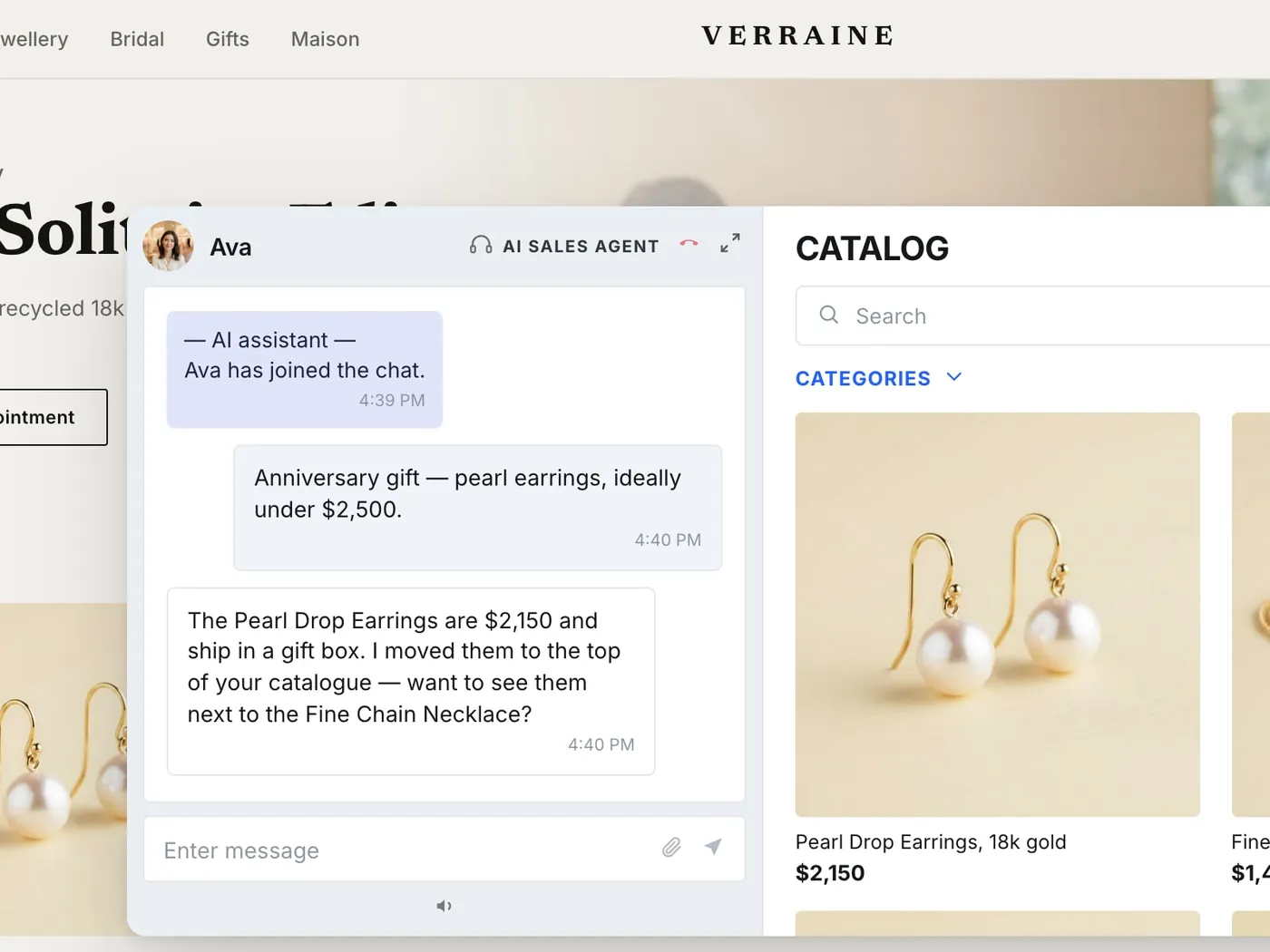
- The AI sales agent does the scale work — engages at the right moment, answers factual questions, qualifies intent, recovers abandoning carts, and closes low-consideration sales in chat.
- The human advisor does the trust work — for high-AOV, high-consideration purchases, the agent routes the qualified shopper to a live, one-to-one video consultation, where a person reads hesitation and guides the decision to a confident close.
This is the bridge between automated engagement and genuine clienteling — software doing what software does best, people doing what people do best.
What the right orientation actually delivers
When the tool is sales-first and the human handoff is built in, the results show up on revenue metrics, not cost metrics. On the Immerss platform, clients see materially higher conversion and meaningfully larger average orders, with proactive intervention recovering a meaningful share of abandoned carts. Those are growth-budget outcomes — the kind a deflection bot is structurally unable to produce.
The 60-day pilot, on us
The fastest way to find out what a sales-first agent does on your traffic is to run one against your highest-intent pages and measure conversion, not deflection. That’s what the pilot is for.
We run a structured 60-day pilot, on us — an AI sales agent handling engagement and qualification, a live one-to-one video consultation handoff for your high-AOV purchases, and measurement built around conversion, AOV, and recovered carts. You change no platform and risk no margin to find out whether the conversion gap you’ve been blaming on your website was really a support-first tool doing exactly what it was built to do.
See the pilot for merchants: landing.immerss.live Agency partner program: partners.immerss.live
Immerss is a luxury live commerce platform — AI sales agents and one-to-one video consultation for fine jewelry, watches, and high-AOV retail, built on Shopify Plus.