

AI-Powered Customer Service Automation: An Implementation Guide for Canadian Retailers
Summary
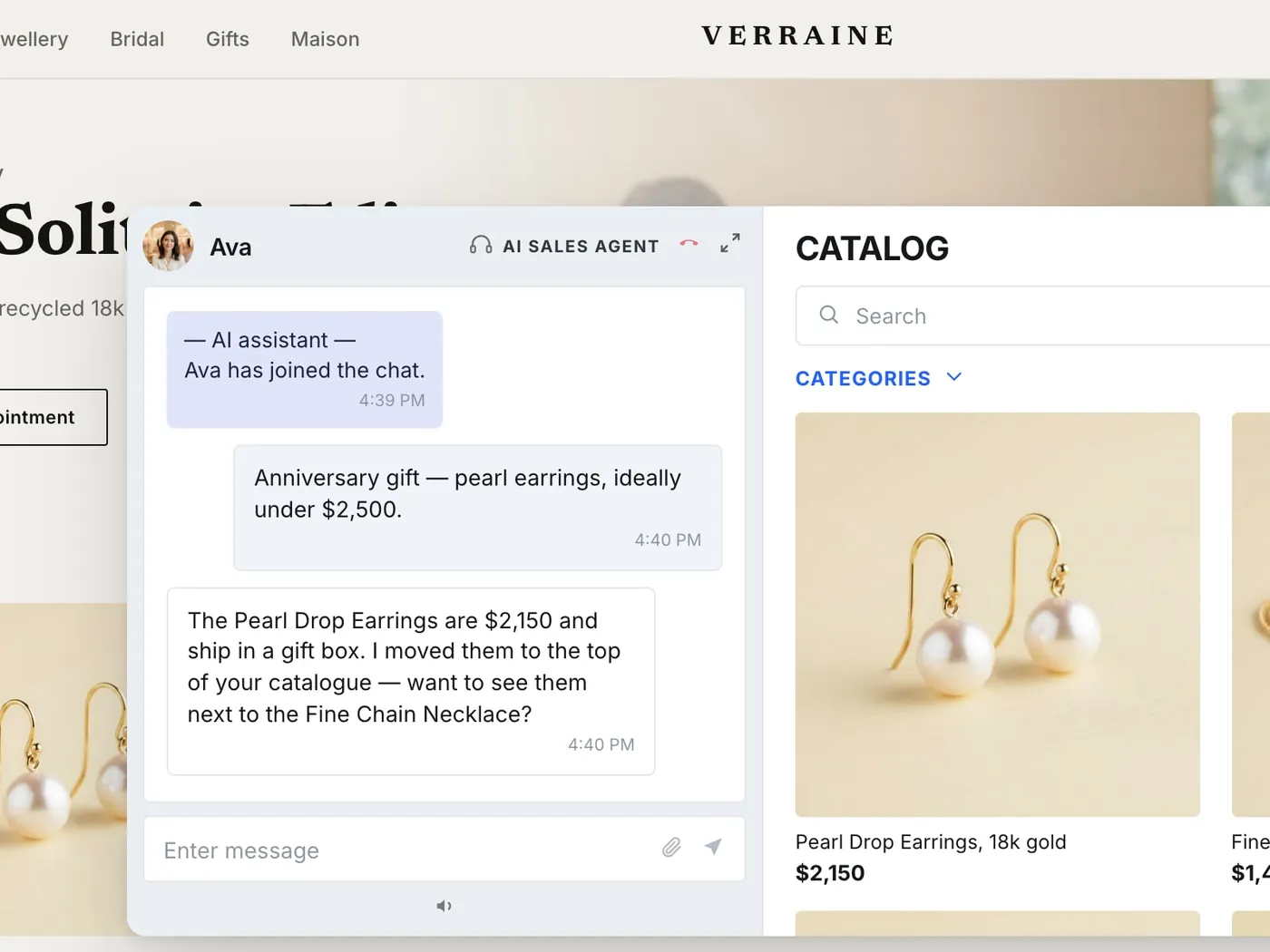
In this article we look at where AI-powered customer service automation actually fits in a Canadian retail operation, what it changes in the buying journey, and how to phase a deployment. We also cover the failure modes — the questions AI should never be the last word on, and what has to stay a person’s job.
Canadian online retailers are facing an unprecedented customer service crisis. With cart abandonment rates soaring to 70% and customer acquisition costs increasing by 38% year-over-year, traditional support methods are failing to meet modern shopper expectations. Retailers deploying AI-powered customer service automation are attacking a specific part of that: the gap between when a shopper’s question arises and when anyone answers it.
Request Executive Demo of AI Customer Experience Solutions →
The Customer Experience Challenge
How does AI help online retailers improve customer service?
The modern Canadian e-commerce landscape presents unique challenges for customer experience managers. Recent studies show that 67% of Canadian online shoppers abandon their carts due to poor customer service experiences, while 84% expect immediate responses to their inquiries—creating an impossible situation for traditional support teams.
The most pressing challenges include:
Operational Inefficiencies
- Average response time of 24-48 hours for customer inquiries
- Support costs consuming 15-20% of total revenue
- Inconsistent service quality across different channels
- Limited availability outside business hours
Customer Expectations Gap
- 89% of Canadian consumers expect 24/7 support availability
- 73% demand personalized shopping experiences
- 61% abandon purchases after negative service interactions
- 45% switch to competitors after one poor experience
Scalability Limitations
- Inability to handle peak traffic periods effectively
- Difficulty maintaining service quality during growth phases
- High employee turnover in customer service roles
- Training costs for new team members averaging $3,200 per hire
What metrics show the effectiveness of AI-driven customer support?
Measure the deployment on things you can attribute, not on a blended conversion rate that moves for a dozen reasons at once:
- Time to first answer, which is the whole mechanism — a question answered in the session is worth more than the same answer tomorrow
- Share of inquiries resolved without a handoff, and, more revealing, which ones keep needing one
- What the escalated conversations were about — this is your product-page gap list, written by customers
- Whether the shopper who asked went on to buy in the same session, tracked as its own cohort rather than folded into the site average
Strategic Implementation Framework
Phase 1: Foundation Assessment and Planning
The journey toward effective AI chatbots for e-commerce begins with comprehensive analysis of existing customer service workflows. Successful Canadian retailers start by mapping their current customer journey and identifying critical interaction points where AI-driven personalization to boost e-commerce sales can have maximum impact.
Customer Data Analytics Integration
- Analyze historical support tickets and common inquiry patterns
- Identify peak traffic periods and resource allocation gaps
- Map customer behavior across all touchpoints
- Establish baseline metrics for conversion tracking
Technology Infrastructure Evaluation
- Assess current CRM integration capabilities
- Review existing e-commerce platform compatibility
- Evaluate data security and privacy compliance requirements
- Plan for omnichannel retail strategies integration
Phase 2: AI Solution Design and Customization
Best conversational AI chatbots for e-commerce customer experience require careful customization to match brand voice and customer expectations. The implementation process focuses on natural language processing capabilities that can handle complex customer queries while maintaining human-like interaction quality.
Core Functionality Development
- FAQ automation with intelligent routing capabilities
- Product recommendation engines based on browsing behavior
- Order tracking and return management automation
- Multilingual support for Canada’s diverse customer base
Personalization Engine Configuration
- Real-time customer behavior analysis
- Dynamic product suggestions based on purchase history
- Contextual conversation management
- Integration with existing marketing automation tools
Phase 3: Advanced Feature Integration
Do AI chatbots reduce customer support costs for retailers? The answer becomes clear during the advanced implementation phase, where sophisticated features dramatically improve operational efficiency while enhancing customer satisfaction.
Intelligent Escalation Management
- Seamless handoff to human agents when needed
- Context preservation throughout conversation transfers
- Priority routing based on customer value and inquiry complexity
- Automatic follow-up scheduling for unresolved issues
Omnichannel Experience Optimization
- Consistent experience across web, mobile, and social platforms
- Cross-channel conversation continuity
- Unified customer profiles with complete interaction history
- Integration with voice commerce and virtual assistants
Schedule Customer Experience Consultation →
Measurable Results and Impact
What a deployment looks like in practice
A fashion retailer running this well tends to deploy in the same order, and the order matters more than the tooling:
- Round-the-clock answering first. Most of the value is in the hours when nobody is at the desk, because that is when the unanswered question turns into an abandoned cart.
- Recommendations second, once the system has enough real conversations to know what customers actually ask for rather than what the merchandiser assumed.
- Proactive engagement third, and narrowly — triggered by behaviour that signals a stuck shopper, not by a timer that interrupts everyone.
- CRM integration throughout, so that the escalation to a person starts with the conversation already in front of them, rather than asking the customer to repeat it.
The failure mode is deploying in the reverse order: proactive pop-ups on day one, on a system that has not yet learned what to say.
ROI of Automated Customer Service in E-commerce
How can machine learning improve customer experience in e-commerce? The financial impact extends far beyond cost savings, creating measurable improvements across all key performance indicators.
Where the revenue actually comes from:
- Baskets grow when a suggestion arrives at the moment the shopper has just said what they want the item for — not from an upsell widget on the confirmation page
- Customers return to a store that answered them, and the record of what they asked makes the second conversation shorter than the first
- Acquisition spend goes further because more of the traffic you already paid for gets past the question that was stopping it
Where the cost comes out:
- Routine inquiries stop reaching the queue at all, which is a headcount question only if you let it be one — the same team handles the hard conversations with more time each
- New staff ramp faster, because the knowledge base assembled for the AI is also the training material
- First contact resolves more often, since the person taking the escalation inherits the whole thread
Key Success Factors and Takeaways
Critical Implementation Strategies
1. Start with High-Impact Use Cases Focus initial implementation on frequently asked questions and simple transaction support. This approach allows for quick wins while building confidence in the AI system’s capabilities.
2. Maintain Human Connection The most successful implementations combine AI efficiency with human expertise. Immerss.live’s hybrid approach ensures complex queries receive appropriate human attention while routine tasks are handled automatically.
3. Continuous Learning Integration Machine learning algorithms for retail require ongoing optimization. Regular analysis of conversation data and customer feedback enables continuous improvement of response accuracy and customer satisfaction.
4. Comprehensive Staff Training Success depends on team adoption and proper utilization. Comprehensive training programs ensure staff can effectively manage AI tools and handle escalated inquiries.
5. Data Privacy and Security Focus Canadian retailers must prioritize data privacy and security in retail applications. Implement robust security measures and ensure compliance with PIPEDA and other relevant regulations.
Best Practices for Training AI Chatbots for Retail
Content Development Strategy:
- Create comprehensive knowledge bases covering all product categories
- Develop brand-specific response templates that maintain consistent voice
- Regular updates based on seasonal trends and new product launches
- Integration of customer feedback for continuous content improvement
Performance Monitoring Framework:
- Daily monitoring of conversation quality and resolution rates
- Weekly analysis of customer satisfaction scores and feedback
- Monthly review of conversion impact and revenue attribution
- Quarterly strategic assessment and feature enhancement planning
Future Trends in AI-Driven Retail
The landscape of automated customer service for online stores continues evolving rapidly. Emerging technologies including voice commerce integration, predictive customer service, and advanced sentiment analysis will further enhance customer experience capabilities.
Emerging Opportunities:
- Integration with augmented reality for virtual product demonstrations
- Predictive analytics for proactive customer outreach
- Advanced personalization using machine learning insights
- Cross-platform customer journey optimization
Conclusion: Transforming Customer Experience Through AI Innovation
The evidence is clear: AI-powered customer service automation represents a fundamental shift in how Canadian retailers can deliver exceptional customer experiences while achieving unprecedented business results. With proven conversion rates of 28% and customer satisfaction scores of 95%, the question is no longer whether to implement AI solutions, but how quickly you can get started.
For customer experience managers ready to transform their operations, the path forward involves strategic planning, careful implementation, and partnership with proven technology providers. Immerss.live’s comprehensive platform has already helped over 200 retailers achieve similar results, processing more than $10 million in sales through intelligent customer engagement.
The competitive advantage belongs to retailers who act decisively. While competitors struggle with traditional support limitations, forward-thinking organizations are already capturing market share through superior customer experiences powered by AI innovation.
Take Action Today:
- Assess your current customer service performance gaps
- Identify high-impact implementation opportunities
- Partner with experienced AI solution providers
- Begin with pilot programs to demonstrate ROI
- Scale successful implementations across all customer touchpoints
Request Executive Demo of AI Customer Experience Solutions →
About Immerss.live: Immerss.live is Canada’s leading AI-powered live shopping and conversational sales engagement platform, helping retailers achieve industry-leading conversion rates through intelligent customer interactions. With over 200,000 completed shopping sessions and $10+ million in documented sales, Immerss.live combines advanced AI technology with human expertise to transform online commerce experiences.
Ready to achieve similar results? Contact our customer experience specialists for a personalized implementation strategy tailored to your business goals.