
Black Friday Strategy for Luxury and High-Ticket Brands
Every Black Friday guide published this year tells you to discount deeper, gate the discount behind a loyalty tier, and stack a bundle on top. On a $3,000 product that advice destroys margin and positioning in the same move. Here’s what replaces it.
The short answer
A discount is a tool for removing a price objection. The high-ticket buyer rarely has one — they have an uncertainty objection, and price cuts don’t touch it. What moves a considered purchase over the line in November is the same thing that moves it in June: access to the piece, a person who can answer for it, and enough certainty about fit, delivery and returns to commit. Black Friday changes the timing and the competition for attention. It doesn’t change the buyer.
So the high-ticket play is VIP-first, by appointment, with a human — an invitation-only window for people you already know, a bookable slot with a specialist, and a live conversation where the object can actually be shown. It protects the price, it’s measurable, and it’s the one thing a marketplace or a discount-led competitor structurally cannot copy.
What every Black Friday guide says this year
Read the current crop — OptiMonk, Saltbox, Eastside, Experian — and the consensus is remarkably consistent:
- go deeper on the markdown, or at least earlier;
- gate the best pricing behind loyalty membership or an email list;
- build tiered spend thresholds so bigger baskets unlock bigger cuts;
- add bundles and gift-with-purchase to protect the headline price;
- extend the event from a weekend to a six-week trading period.
None of this is wrong. It is written, carefully and competently, for a basket worth sixty dollars — where the decision takes seconds, margin is recovered across volume, and a countdown timer genuinely changes behaviour. The mechanics are sound for that shopper.
The problem is what happens when you apply them unchanged to a piece worth three thousand.
Why the same advice inverts at $3,000
The arithmetic stops working. A fifth off a $60 order is twelve dollars, and you may well make it back on the next two orders. A fifth off a $3,000 piece is six hundred dollars, given away on a single unit — and high-ticket volume doesn’t respond to promotion the way commodity volume does. There is no version of “we’ll make it up on scale” for a product someone buys once every three years.
The price is a claim, and the discount revises it. For considered goods, the number is part of the argument for the object: this is what this level of material, provenance and workmanship costs. A sitewide markdown says the argument was negotiable all along. That’s a permanent edit to how the brand is read, made in exchange for a temporary revenue bump.
You train a long deliberation window to wait. High-consideration buyers research for weeks. Teach them that November is when the price moves, and you don’t create demand — you relocate it, pulling full-price purchases out of September and January into a discounted weekend. The cost shows up in months that have nothing to do with Black Friday.
And the top of your category simply doesn’t play. Rolex and Patek Philippe hold price and manage scarcity through allocation instead. Hermès, Chanel, Louis Vuitton, Cartier and Bulgari maintain price through their own channels across the weekend. Whatever else that is, it isn’t an oversight — it’s the position your brand is being compared against.
What the buyer is actually stuck on
If price isn’t the blocker, it’s worth being precise about what is. On a high-ticket purchase — and especially on a high-ticket gift, which is what most of Q4 is — the unresolved questions look like this:
| The question in the buyer’s head | What a discount does about it |
|---|---|
| Will this fit — the wrist, the finger, the room? | Nothing |
| Is the scale and finish what the photography suggests? | Nothing |
| Is this the right piece for this person? | Nothing |
| Can it arrive, engraved, before the date? | Nothing |
| If it’s wrong, how painful is the exchange? | Nothing |
| Am I about to make an expensive mistake? | Makes it cheaper to make |
This is a conversation problem wearing a conversion problem’s clothes. We’ve written about the underlying pattern at length in why high-ticket items don’t sell online and about the gift-buyer variant specifically in the Q4 holiday gift concierge playbook — Black Friday doesn’t introduce a new dynamic, it concentrates the existing one into four weeks.
The three moves that replace the discount
1. VIP-first, not public-first
Your known customers are the highest-converting audience you will have all year, and on Black Friday they are the ones being competed for hardest by everyone else’s inbox. Reach them before anything public exists: a private window, an invitation with a name on it, first access to limited pieces, priority on engraving and delivery slots.
The mechanism is outbound clienteling — associates contacting their own book with a specific reason to talk, not a blast. It costs nothing in margin, and it converts on relationship rather than on price.
2. By appointment, not by countdown
Replace the timer with a calendar. A bookable slot with a specialist does the same job the countdown was hired to do — it creates a real date, a commitment, and a reason to act this week — without asserting that the price is temporary. And unlike a timer, it’s true.
Practically: open a calendar of consultation slots before the window opens, staff it like a shop floor with actual coverage hours, and hold the highest-value slots for the VIP list. The scarce resource you’re promoting is expertise and attention, both of which are genuinely finite.
3. With a human on camera
This is the part software usually skips. A live one-to-one video consultation lets an associate rotate the piece under real light, hold it against a wrist for scale, explain why one movement or one setting costs what it costs, and answer the exchange question directly. Every row in the table above resolves in that call. None of them resolve on a product page.
It scales in two directions. One-to-one for the highest-value buyers and the anxious gift buyer, where a booked session is worth more than any offer you could put in an email. One-to-many — a live shopping event or shoppable video on the product page — for the rest of the list, where the format is a lookbook you can ask questions in.
This isn’t hypothetical for the segment, either. Shinola publishes a complimentary virtual appointment as a product in its own catalogue: personalised recommendations, a live walkthrough of details, finishes and scale, guidance on movements and care, no obligation to buy. Note that they also run a sitewide markdown over the weekend — the two aren’t mutually exclusive, and the appointment is the half that protects the price.
Here’s the substitution, stated plainly:
| What the discount was doing | What replaces it |
|---|---|
| Creating urgency | A booked appointment with a real date |
| Signalling “now is special” | An invitation-only window before anything public |
| Overcoming hesitation | A person who answers the actual question |
| Reaching the whole list at once | A live event with the catalogue in it |
| Being easy to measure | Sessions booked, held, and attributed to revenue |
If you want to see the one-to-one and event formats running against your own catalogue, book a demo — it’s the fastest way to judge whether the mechanics fit your November.
What’s table stakes, and don’t mistake it for strategy
Buy-now-pay-later has become an expected fixture at high-ticket checkout rather than a differentiator. Affirm supports carts well into five figures and is deployed across fine jewelry and watch retailers; Klarna and Afterpay are similarly common in the category. If a buyer is choosing between you and a competitor who offers financing and you don’t, that’s a defect worth fixing before November.
But be clear about what it does. Financing removes a cash-flow objection. It does not remove uncertainty about the piece, the fit, or the recipient — and on considered purchases, uncertainty is the objection that actually costs you the order. Ship BNPL because it’s expected. Don’t file it under strategy.
Why this is an August decision, not a November one
The single most common way high-ticket brands end up discounting is that they run out of time to do anything else. In the second week of November the only lever left is the one that requires no preparation.
| When | What has to happen |
|---|---|
| August | Decide the mechanic. Publish and interlink the pages the campaign will point at — new content needs weeks to be indexed and to gather signals before traffic arrives |
| September | Segment the book. Who gets the VIP window, who gets the event, who gets the standard sequence. Instrument the measurement before there’s anything to measure |
| October | Open the appointment calendar. Staff and rehearse: on-camera coverage hours, lighting, catalogue in the call, handoff from AI qualification to associate |
| November | Run the VIP window first, the public window second, the live events through the weekend. Nothing new gets built this month |
| December–January | Read the results by session and cohort, not by weekend total — the post-BFCM analysis framework is the discipline for this |
Today is early August. That’s the comfortable end of this calendar, and it’s the reason the decision is worth making now rather than in six weeks.
Making it measurable
The honest objection to everything above is that a discount is legible and a conversation isn’t. Finance can price a markdown; nobody has ever put “the associate was reassuring” in a model. That objection is fair for clienteling done over text messages and phone calls — and it dissolves the moment the conversation happens on instrumented infrastructure.
What to track through the window:
- appointments booked versus held — the honest measure of whether the offer of attention landed;
- revenue attributed to assisted sessions, separated from the rest of the weekend;
- average order value on assisted versus unassisted orders — the number that usually settles the internal argument;
- what the VIP window produced before the public one opened — the direct test of whether access outperformed price for your list;
- follow-up conversion after the window, where consultative selling tends to pay a second time.
That’s the whole proposition, and it’s why we describe the platform as human, personal and measurable: a person does the selling, the buyer is treated as someone specific rather than as a segment, and the outcome lands in a report instead of an anecdote.
Where this sits in the platform
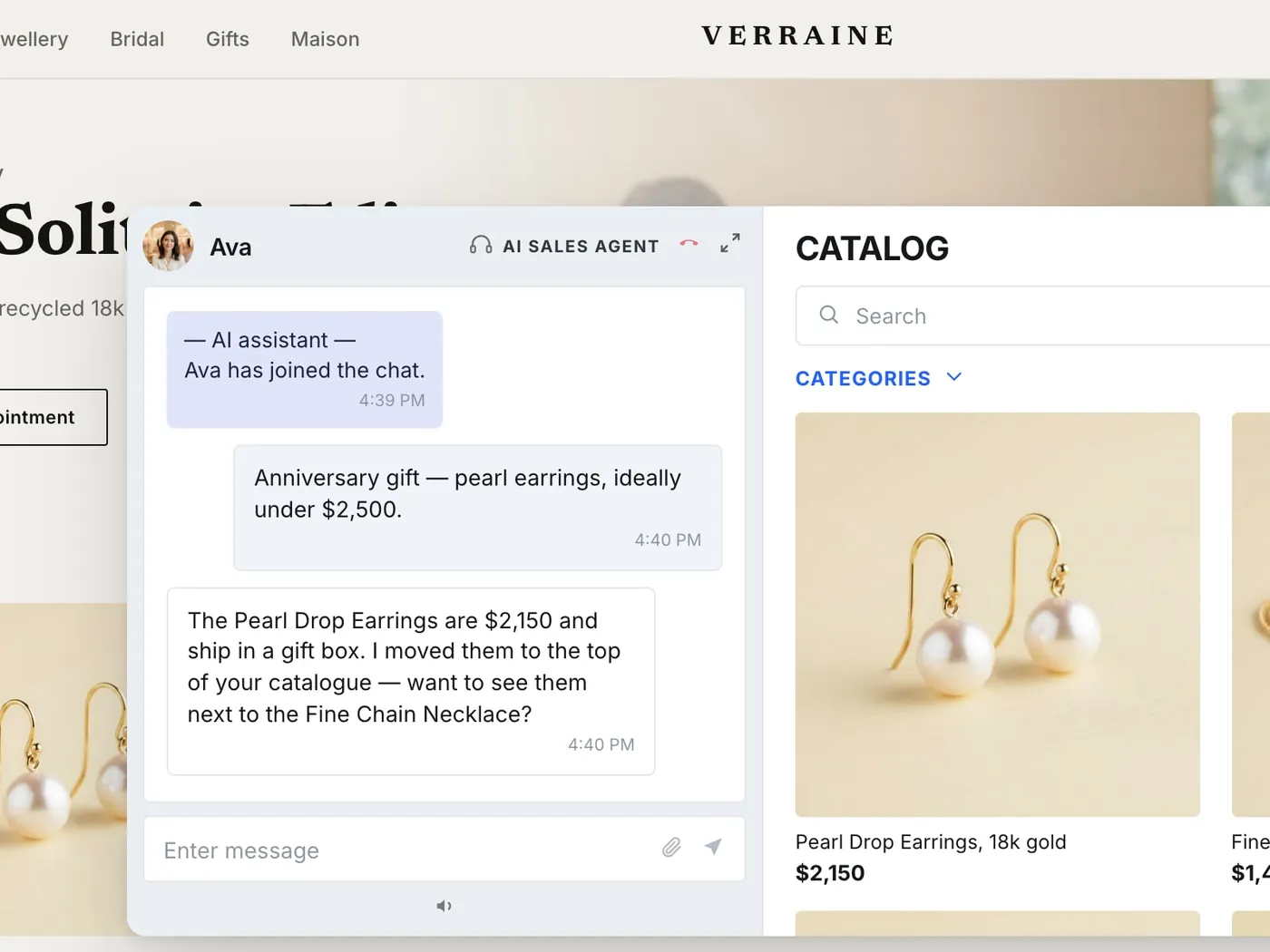
The three moves map onto two modules. Clienteling covers outbound to a known book and one-to-one live co-shopping — the VIP window and the appointment. Video Commerce covers live shopping events, shoppable video and on-PDP video — the one-to-many half, for the list you can’t book individually. An AI Sales Agent sits ahead of both, qualifying and routing so that associate hours land on the sessions worth having.
On what it costs to run: pricing is banded by monthly traffic per module, with a free tier at the entry of each — see /pricing for the current figures rather than a number quoted in an article that will age. For a brand in the $10M–$500M range planning a multi-module Q4 programme, the entry point is a conversation, and we run a 60-day pilot, on us.
The one-line version
On a $60 basket, the discount is the strategy. On a $3,000 piece, the discount is what you do when you didn’t build a strategy in August. The alternative is not a cleverer offer — it’s putting a person back into the most valuable four weeks of your year, and instrumenting the result well enough to do it again.
If discounting is a year-round habit rather than a November one, the companion piece is how to increase AOV on high-ticket products without discounting.
Frequently asked questions
Most shouldn't — at least not sitewide. On a high-ticket product, a markdown gives away a large absolute sum per unit and can't be recovered on volume, because considered purchases don't scale with traffic the way a $60 basket does. It also revises the price claim the product is built on. The top of the market opts out entirely: Rolex, Patek Philippe, Hermès, Chanel, Louis Vuitton, Cartier and Bulgari hold price through the weekend. The workable alternative is access and attention — VIP-first windows, booked appointments, and a real person on video — rather than price.
Access, service and certainty. Early or invitation-only windows for known customers, a booked one-to-one appointment with a specialist, live product walkthroughs on video, curated bundles and gift-with-purchase, priority delivery and engraving slots, and extended or guaranteed holiday returns. Each of these answers what actually blocks a high-ticket buyer — uncertainty — while a discount only answers a price objection most of them didn't have.
Because it's written for low-consideration baskets. Deeper markdowns, countdown timers and tiered spend thresholds work when the decision takes seconds and margin is recovered across volume. A $3,000 purchase takes days or weeks, involves questions about fit, materials and delivery, and is often a gift bought under anxiety. Speed tactics don't shorten that decision — a conversation does.
By late summer. A new landing page or guide needs time to be indexed and to accumulate signals before November traffic arrives; the VIP list has to be segmented and warmed; associates need to be scheduled and rehearsed on camera. Brands that start in November are left with the only lever that requires no preparation — a discount — which is precisely how the discount habit forms.
It's table stakes, not a strategy. Affirm and Klarna are widely deployed across fine jewelry and watch retailers, with Affirm supporting carts well into five figures, and high-ticket buyers increasingly expect to see a financing option at checkout. It removes a cash-flow objection, which is useful. It does not remove uncertainty about the piece itself, and that is the objection that costs you the sale.
Open a bookable calendar of specialist slots ahead of the window, invite your known customers into it before anything goes public, and staff it like a shop floor. Immerss handles this as Clienteling: an AI Sales Agent qualifies and routes the shopper, an associate takes the appointment on live one-to-one video with the catalogue in the call, and checkout happens inside the session — so the outcome is attributed rather than assumed.
By session, not by sentiment. Track appointments booked versus held, revenue attributed to assisted sessions, average order value on assisted versus unassisted orders, and what the VIP window produced before the public one opened. That comparison is the argument for doing it again next year, and it's the reason to instrument the programme before November rather than after.