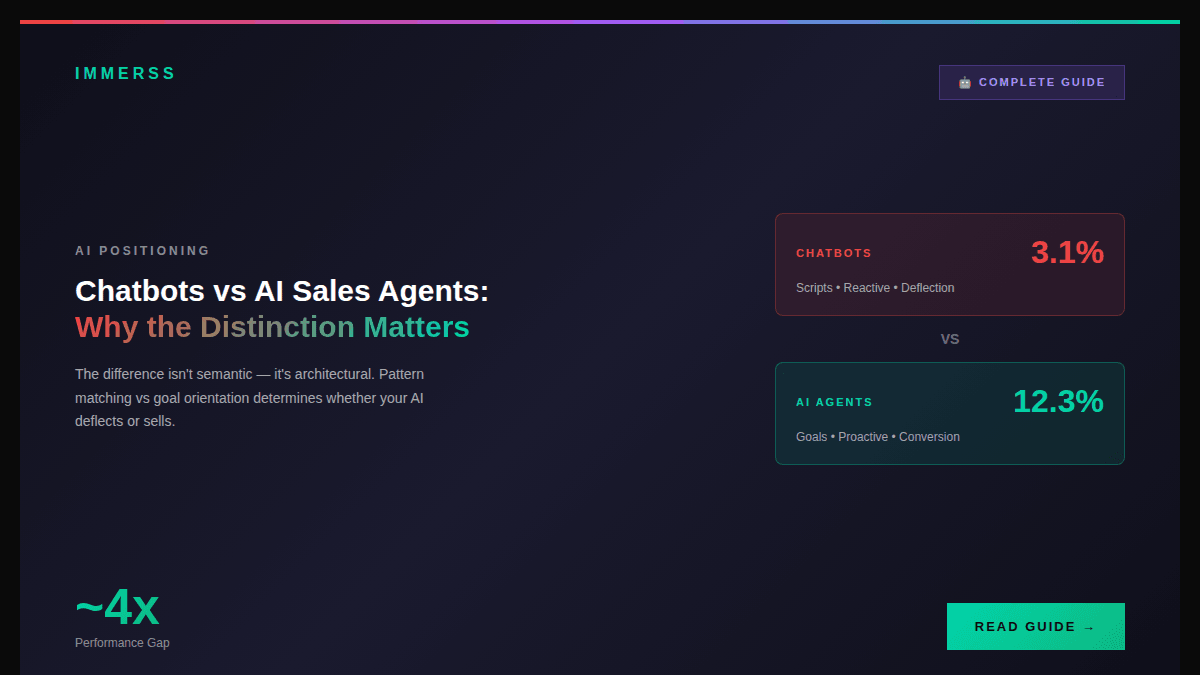

Chatbot vs AI Sales Agent: What's the Difference in 2026?
If you already have a chatbot on your store and you are wondering why it has not grown sales, the answer is not that it needs better training. A support chatbot and an AI sales agent are built for opposite jobs. One is built to deflect — to end conversations and keep tickets away from a human. The other is built to sell — to recommend the right product, add it to the cart, and move the shopper toward checkout. They occupy the same corner of the same page, but one is a bouncer and the other is a salesperson.
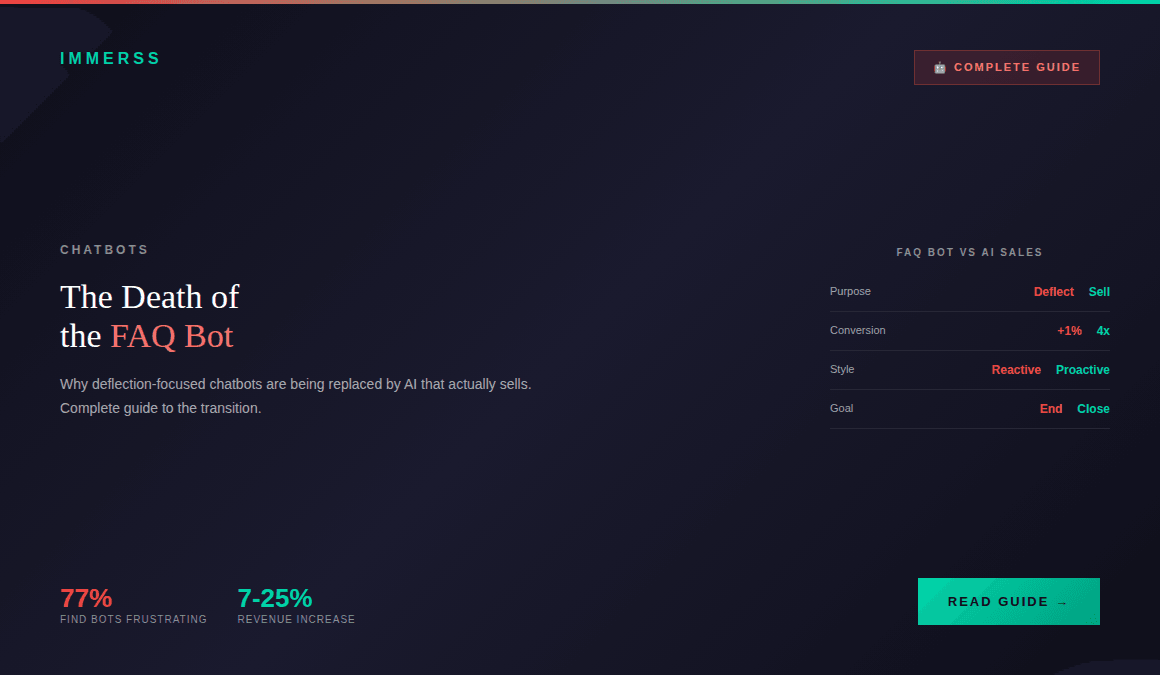
The short version: a chatbot answers and ends the conversation; an AI sales agent recommends, adds to cart, and closes.
This guide explains the difference, how to tell which one you are running today, and how to measure whether the tool you have is actually selling.
One note on vocabulary before we start, because it is part of the confusion. The same two things get sold under a dozen names: e-commerce chatbot, AI assistant, AI shopping assistant, sales chatbot, support bot, AI agent. The labels do not track the distinction — plenty of tools marketed as “AI assistants” are support-first, and plenty of “chatbots” sell. Ignore what it is called and ask what it is built to do.
What is the difference between a chatbot and an AI sales agent?
The difference is purpose. A support chatbot is optimized to deflect tickets and end conversations. An AI sales agent is optimized to recommend products, add them to the cart, and move shoppers toward checkout.
A support chatbot succeeds when a conversation ends without a human: it points to the FAQ, surfaces the tracking page, resolves the issue, closes the chat. An AI sales agent succeeds when a browse becomes a purchase: it reads what the shopper is looking at, recommends the right product, handles hesitation, and carries the sale forward.
Same location on the page, opposite objectives. One reduces support workload; the other is answerable for revenue. Knowing which job you actually need is the whole decision.
What is a support chatbot built to do?
A support chatbot is built for deflection — reducing the number of emails and tickets that reach a person. That is a legitimate and useful job. Every “where is my order?” the bot handles is one your team does not answer.
To do it, the tool is optimized end to end to close conversations efficiently: identify the question, surface the relevant answer or link, resolve, end the chat. Its definition of success is a conversation that finished without human involvement — which means the entire product is engineered to make the interaction stop.
That is exactly right for support and exactly wrong for selling, because a store’s conversion problem is that too many conversations stop before anyone buys. A support chatbot is a machine for winding conversations down, installed on a store that needs them moved forward.
What is an AI sales agent built to do?
An AI sales agent is built to turn conversations into sales. Its orientation is the mirror image of a chatbot’s: where the chatbot wants the conversation to end, the agent wants it to progress.
Three things make that possible:
- It knows your catalogue. It syncs every product, variant, price and policy and answers from that, rather than improvising beyond what you actually sell.
- It follows context. It tracks what the shopper is looking at and what they have already said, so the answer is personal to this shopper rather than generic.
- It completes the action it recommends. It places the right variant in the cart and moves the shopper toward checkout.
There is a fourth thing it does that a support tool structurally cannot: it arrives at the moment of hesitation instead of waiting to be asked. A support chatbot is reactive by design — it opens when the shopper opens it, which means it is absent for exactly the shoppers who never type anything and simply leave. Someone comparing two variants for the third time, or sitting on a full cart without proceeding, has not raised a support ticket and never will. That is where most abandoned carts are decided, and a tool built to answer questions is never in the room. This is also why cart abandonment is a sales problem rather than a support one: the shopper did not have a question, they had a doubt.
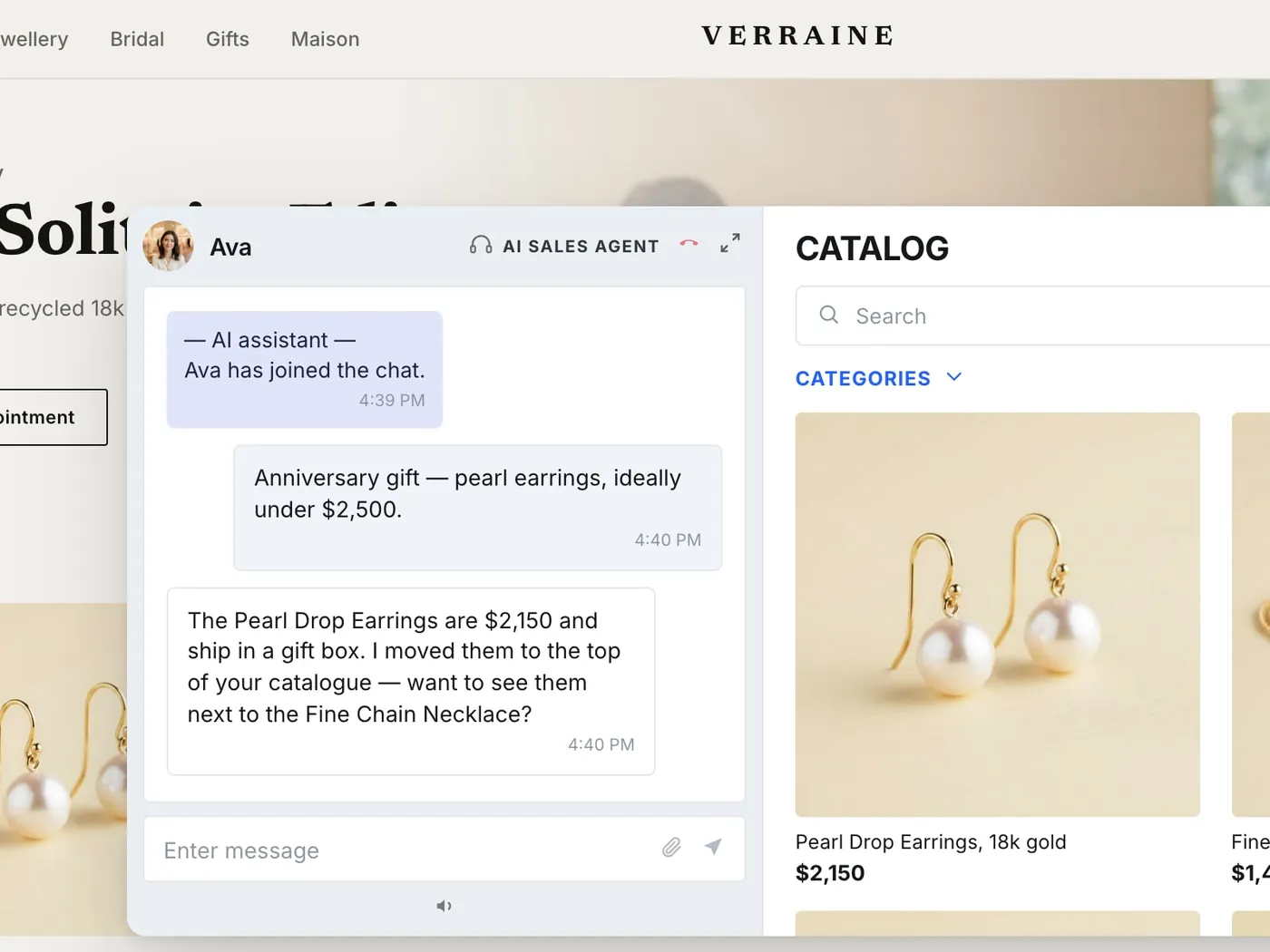
That third capability is the one that separates the categories. A good AI sales agent behaves like your best floor associate: it reads intent, recommends, handles hesitation, and closes — in every timezone, at any hour. For the full picture of what that looks like in practice, see our guide to an AI sales agent that works your floor 24/7.
Is a chatbot the same as an AI sales agent?
No — even though they look identical on the page.
The confusion is understandable. Both appear as a bubble in the corner, both answer questions, both are described as “AI.” But they are built from opposite premises. No amount of tuning turns one into the other, because they are pointed in different directions: you cannot nudge a tool designed to end conversations into one designed to advance them.
Treating them as interchangeable is the most expensive mistake in this category. It convinces a brand it has addressed selling when it has only addressed support.
How can I tell which one I have?
Two questions, no technical inspection required.
First: does it recommend, or only respond? A support chatbot answers the question you asked and stops. An AI sales agent answers and then moves the shopper forward — “based on what you are after, here is the one I would point you to.”
Second, and decisively: can it add the item to the cart and take the shopper toward checkout, or does it only talk? This is the tell. A support chatbot lives in an information silo: it can describe, link and explain, but the buying happens somewhere else and the shopper has to leave the conversation to do it. An AI sales agent closes the loop.
If your current tool can only answer and point, it is a support chatbot, however pleasant its answers are.
Which category is the tool I already have?
Two checks that need no demo and no vendor call.
Check where the product came from. Most of the chat widgets on e-commerce stores began life as helpdesk software, and the origin still shapes the product:
- Gorgias — a helpdesk built for e-commerce, organised around support tickets and order actions.
- Zendesk — customer-service ticketing, the category’s original template.
- Intercom — business messaging, oriented toward conversations with customers and support resolution.
- Tidio — live chat with chatbot automation, aimed at small and mid-size merchants.
These are good products doing the job they were designed for. None of them was designed to carry a browse to a purchase, which is why bolting a sales expectation onto one disappoints.
Then check how it bills you — the fastest tell in the category, and the most durable, because pricing pages outlive feature lists. Support-first tools charge against volumes of resolved conversation: Gorgias meters billable tickets, Tidio meters billable conversations, Zendesk and Intercom sell seats and tiers. Read that as an incentive statement. When a vendor’s revenue is a function of tickets handled or conversations closed, the entire product is tuned to close them — efficiently, cheaply, and permanently. It is doing exactly what it is paid to do.
A selling tool cannot be priced that way, because ending the conversation is the failure case. Ours is banded by monthly traffic with a free tier on each module, so the bill is fixed inside a band and a good month moves you up a step deliberately rather than billing you afterwards for your own success — the current numbers live on our pricing page, and each vendor’s live figures belong on theirs. If you want the named-tool version of this comparison, we keep one: a sales-first alternative to Gorgias and Tidio.
Chatbot vs AI sales agent: side by side
- Goal: support chatbot → deflect tickets; AI sales agent → advance the sale.
- Definition of success: chatbot → the conversation ended without a human; agent → a browse became a purchase.
- Behaviour: chatbot → answers and stops; agent → recommends and develops the conversation.
- Cart: chatbot → cannot add to cart; agent → adds the right variant and moves to checkout.
- Context: chatbot → answers the literal question; agent → follows browsing signals and accumulated intent.
- Human path: chatbot → hands off to a support inbox; agent → brings a named advisor onto live video to close.
- What it changes: chatbot → lower support workload; agent → revenue from traffic you already paid for.
Both have a place. The mistake is expecting the first to do the job of the second. For how these two compare against live commerce as a third approach, see the AI sales agent, chatbot and live commerce comparison.
What happens when the shopper needs a person?
For a considered purchase, there is a moment where the AI should stop selling and hand over. A shopper weighing a piece of fine jewellery, an expensive watch, or a first purchase from a brand they do not yet trust is not blocked by a missing fact — they want a person to take responsibility for the recommendation.
This is where a sales-first architecture differs from a smarter bot. On Immerss the agent escalates with one tap into Live Co-Shopping: a named advisor joins on live video, sees what the shopper is looking at, recommends in real time, and puts items into the cart during the call. It is part of the Clienteling module, alongside outbound follow-up to the clients an advisor already knows by name.
Alongside it sits Video Commerce — live shopping events, a shoppable video library, and video on the product page — for the shoppers who want to be shown the product before they ask anyone anything.
The point is not the number of modules. It is that the conversation has somewhere to go when the AI reaches the edge of what it should decide alone. A support chatbot’s escalation path leads to a ticket queue; a sales agent’s leads to a person who can sell.
There is a second, quieter reason this matters, and it is about your side of the conversation rather than the shopper’s. Advisor time is the scarcest thing a brand with a real clienteling team owns, and it is wasted on browsers who were never going to buy. An agent that qualifies before it escalates — what the piece is for, what the timeline is, whether this is an existing client — means the human joins conversations that are already worth a human. That is the difference between a widget that generates work and one that generates appointments.
Our co-founder and CEO, Arthur Veytsman, put the distinction in terms of who is on the other end. A chatbot is fine for whether an item is in stock, basic sizing, an order status — “but that’s a call center-type of employee whose job is measured on how many calls they take, how efficiently they answer those calls. They’re not there to create a relationship.” What is missing online, he argued, is the associate who can talk about how a product looks, feels and fits.
That gap is most visible in categories where the product genuinely has to be explained. Lucchese, the Texas bootmaker and our first client, sells a product people expect to try on: fit varies by last, by leather, by style, and a size alone does not settle it. Their associates now take those conversations on live video instead of losing them to a size chart — the same expertise that used to be available only to whoever walked into the store.
Do I need a chatbot or an AI sales agent?
Whichever matches your actual problem — and most brands that already have a chatbot need the agent.
If your problem is repetitive post-purchase email, a support chatbot is the right tool and will pay for itself. If your problem is that interested visitors browse, hesitate and leave, a support chatbot will not fix it, because deflection is not conversion.
The common trap is having solved the support problem and assuming selling is covered too — then buying more traffic to push into a funnel with a bouncer at the top and nobody selling. If you are paying to attract visitors who then leave without buying, the highest-leverage fix is not more traffic and not a smarter chatbot.
In practice most stores end up running both, and that is the right answer rather than a compromise. The boundary that works is the purchase itself: before it, selling; after it, support. Product discovery, comparison, fit and hesitation belong to the sales agent. Order status, returns, refunds, account and policy questions belong to the helpdesk, which is better at them and has the authenticated order data to act.
What makes the pair work is that the boundary leaks in both directions, so the handoff has to run both ways:
- Sales to support. A pre-purchase conversation turns out to be about a delayed order. Pass it to the helpdesk with the conversation attached, so the shopper does not repeat themselves.
- Support to sales. Far more valuable and almost always missed. A ticket about a return contains “it was too small — do you have it in a wider fit?”, which is a buying question wearing a support ticket’s clothes. If your only path there is a refund macro, the store is refunding purchases it could be exchanging.
Run them as two systems with one shared view of the customer, measured separately: deflection for the one, revenue for the other. Blending the metrics is how a store convinces itself the chatbot is selling.
Can an AI sales agent add products to the cart?
Yes, and this is precisely what distinguishes it from a support chatbot.
A support chatbot can tell a shopper which product fits their needs, but the shopper then has to leave the conversation, find the product, choose the variant and add it themselves. Every one of those steps is a place to drop out.
An AI sales agent completes the action it recommends: it places the right variant in the cart and carries the shopper toward checkout, the way a floor associate walks you to the register rather than pointing at a shelf.
Can I make my existing chatbot smarter instead?
Usually not, because the limitation is structural rather than a matter of intelligence.
You can tune a support chatbot to answer faster and more accurately, and you will have a faster, more accurate deflection tool. But accuracy does not supply the two things selling requires: an orientation toward advancing the conversation rather than ending it, and the concrete ability to recommend a specific product and put it in the cart. Most support chatbots have no connection to the cart at all, because closing was never in their design.
So the move from support to sales is not more intelligence bolted onto a deflection tool. Keep the support chatbot for tickets if it earns its keep; add a tool built from the start to recommend, add to cart, and close.
How to tell whether the tool is actually selling
Do not accept a vendor’s uplift number, including ours. The only figures that mean anything are the ones from your own store, and a sales-first tool should make them measurable from the first week. Watch these:
- Share of assisted sessions that reach a cart. The single cleanest signal of whether the tool advances or ends conversations.
- Assisted versus unassisted orders, compared over the same period and the same traffic mix — not against a vendor benchmark.
- Average order value on assisted orders, which tells you whether recommendations are relevant enough to be accepted.
- What happens after the answer. If sessions consistently end one message after the tool responds, you are running deflection regardless of what the product is called.
- Escalation-to-order rate, once a human path exists — the measure of whether handing over to an advisor is worth an advisor’s time.
If you want a reference point for where your own funnel currently sits, our e-commerce benchmarks page is a more honest starting point than any vendor claim.
How to move from a support chatbot to an AI sales agent
A practical path that does not require ripping out what works:
- Keep the support chatbot for tickets. It is earning its keep on “where is my order?” — leave it there.
- Name the real goal. If it is revenue from traffic you already have, you need a selling tool, not a better support tool.
- Connect the catalogue. The agent must answer from your real products, variants, prices and policies, never improvising.
- Require cart and checkout. This is the line between responding and selling; make it a condition, not a roadmap item.
- Build in the human path. One tap to a named advisor on live video for the expensive or hesitant purchase.
- Run it as a pilot and measure it. Agree the numbers above before launch, then read them.
That last step is the one worth insisting on. A 60-day pilot, on us, on a defined slice of your traffic, judged on numbers you chose in advance, tells you more than any case study — including ours. If that is the conversation you want to have, see it running on your store.
The floor associate your store never had
The reason this was out of reach was staffing. You cannot put a floor associate on a website that is open every hour in every timezone, and for most brands the economics of trying never worked.
An AI sales agent removes that constraint — and, done properly, it does not remove the human. It handles the conversations that need speed and accuracy, and it knows when to bring in a person for the ones that need judgement. That combination is the point: personal enough to be worth having, human where it counts, and measurable enough that you can tell.
Frequently asked questions
No. Both appear as a chat bubble, but a support chatbot is built to deflect tickets and end conversations, while an AI sales agent is built to recommend products, add them to the cart, and carry the shopper to checkout. They are optimized for opposite outcomes: one lowers support workload, the other is answerable for revenue.
Rarely, and not by design. A support chatbot is engineered to close conversations efficiently, which is the opposite of what selling requires. It earns its keep by reducing support workload. Growing revenue from the same traffic is the job of an AI sales agent that recommends, adds to cart, and moves shoppers toward checkout.
Ask two questions. Does it recommend a specific product rather than only answering what was asked? And can it put that product in the cart and take the shopper toward checkout? If it can only answer and point, it is a support chatbot, however good its answers are.
Most stores end up running both, and the boundary that works is the purchase itself: before it, selling; after it, support. Product discovery, comparison, fit and hesitation belong to the sales agent; order status, returns and policy questions belong to the helpdesk. The handoff has to run both ways — a return ticket that says 'it was too small, do you have a wider fit?' is a buying question, and answering it with a refund macro loses a sale you already had.
No — they are helpdesk and live-chat products, and good ones. Gorgias is a helpdesk built for e-commerce, Zendesk is customer-service ticketing, Intercom is business messaging, Tidio is live chat with automation. Their pricing shows the intent: support-first tools meter billable tickets or conversations, or sell seats, so the product is tuned to close conversations efficiently. That is the right design for support and the wrong one for selling.
A support chatbot answers the question asked and ends the conversation; a sales chatbot — more usefully called an AI sales agent — recommends a specific product, puts the right variant in the cart, and moves the shopper toward checkout. Names are unreliable here: many tools sold as 'AI assistants' are support-first. Judge by whether it can complete the action it recommends.
A sales agent should have a human path built in. On Immerss, one tap brings a named advisor onto live video, where they see what the shopper is looking at, recommend in real time, and place items in the cart during the call. That is Live Co-Shopping, part of the Clienteling module.
Yes, provided it knows when to stop selling and hand over. For a piece of fine jewellery or a high-ticket item, the agent's job is to qualify, answer accurately from your catalogue, and bring in a human advisor at the moment the shopper's questions outgrow it.