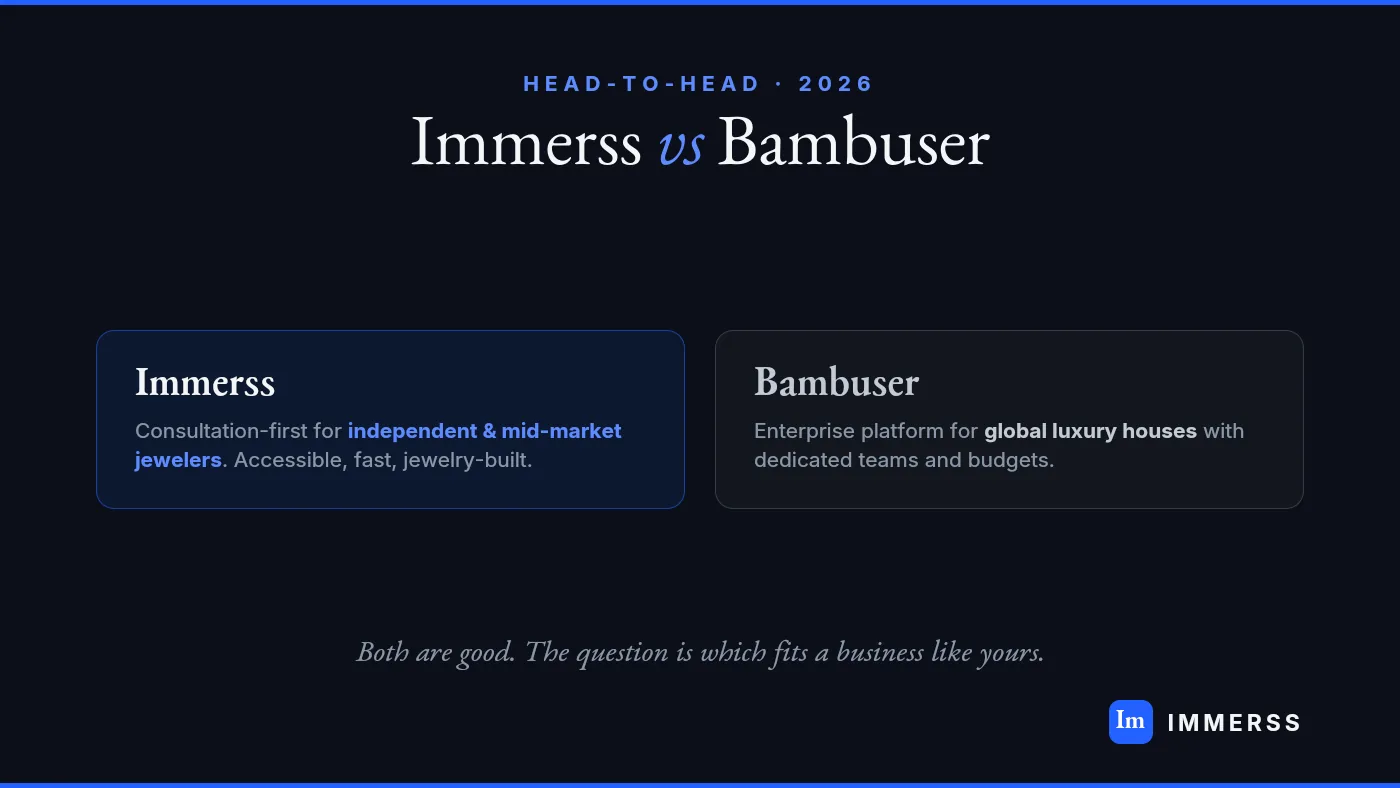

Immerss vs Bambuser (2026): Which Video Commerce Platform Fits Your Selling Motion?
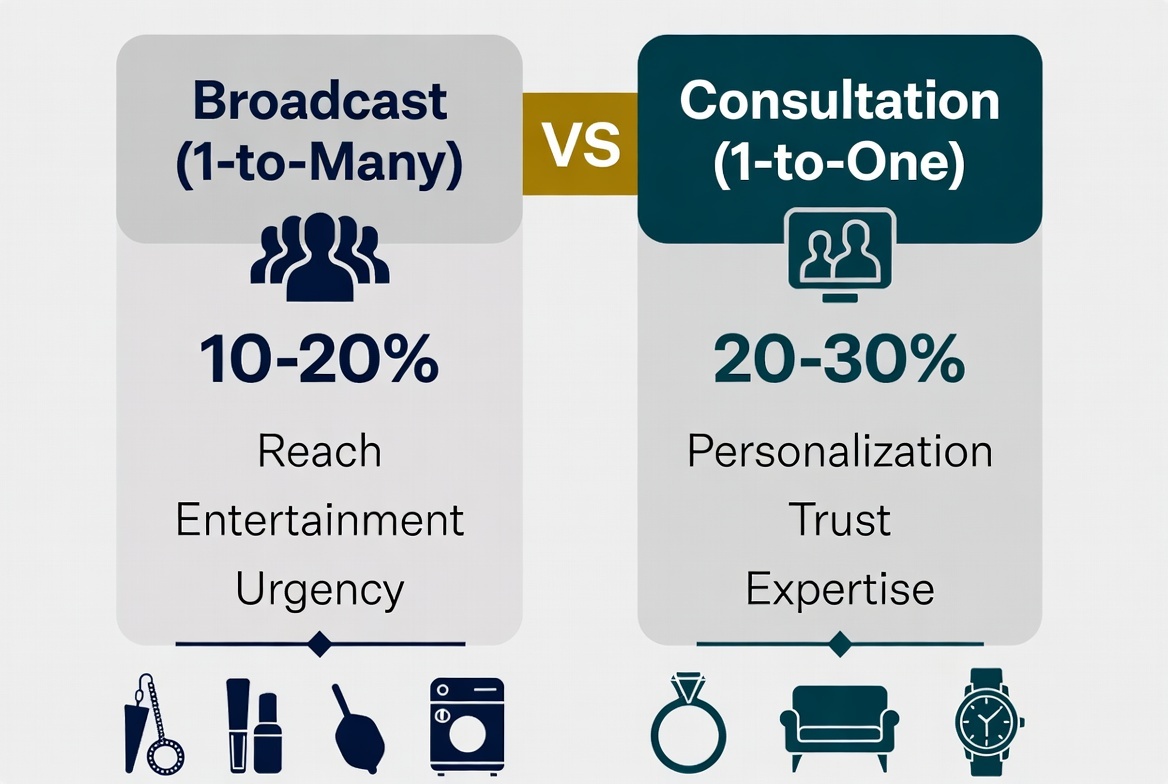
If you are comparing Immerss and Bambuser, you are really deciding between running video commerce as a broadcast programme or as a one-to-one selling motion. That is the fork, and it matters more than any feature checklist — both platforms cover the core capabilities, and a checklist cannot see the cost, the operating model, or the fit behind each checkmark.
We have tried to write the comparison we would want to read about ourselves. Where Bambuser is stronger, we say so.
What is the difference between Immerss and Bambuser?
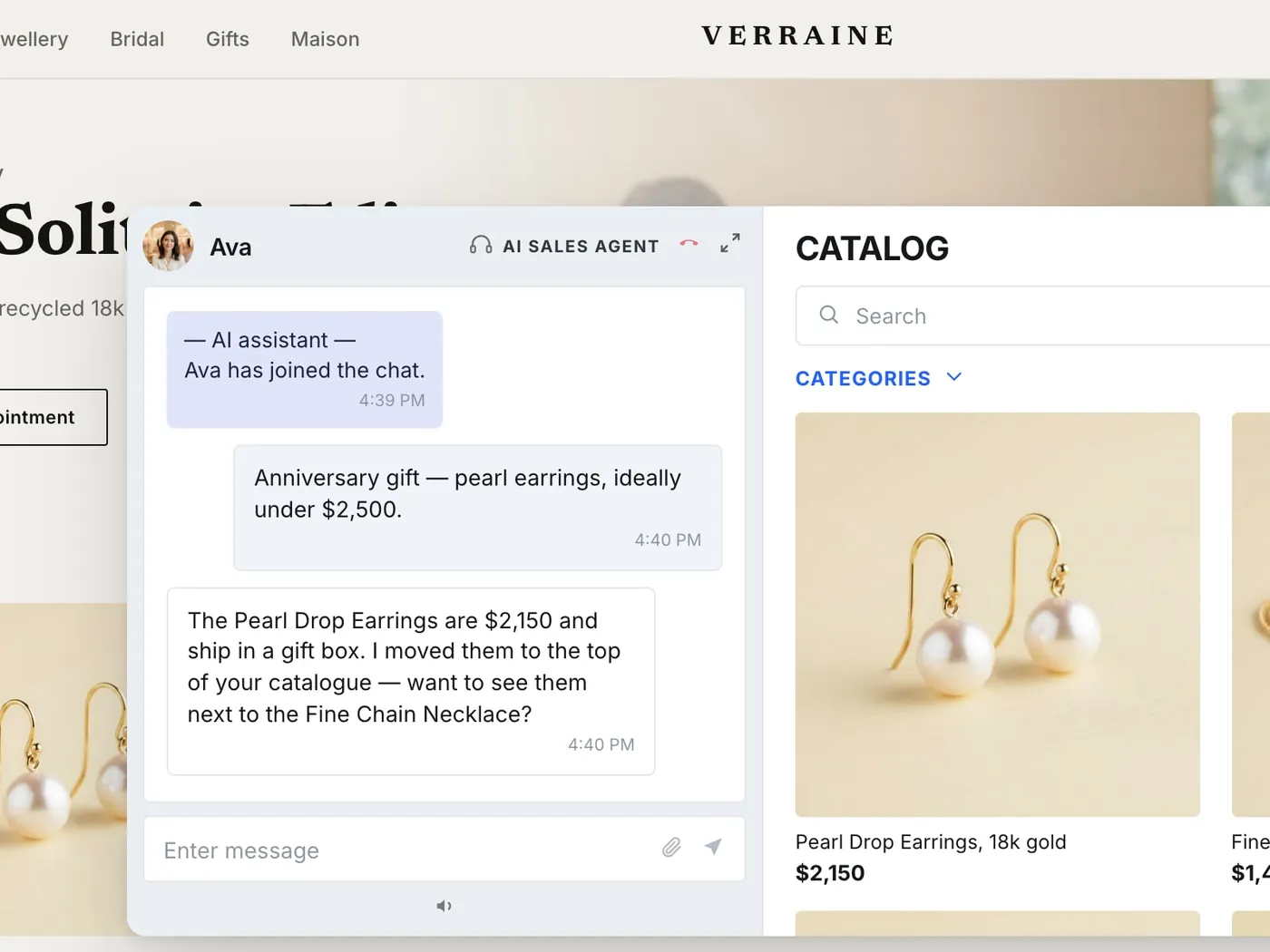
Bambuser is a video commerce platform built around live shopping at scale, with one-to-one consultation as one product line in a broader suite; Immerss is a live commerce platform built around one-to-one selling — an AI Sales Agent that answers shopper questions and escalates to a human on live video — with livestream events as part of the suite.
Both companies offer both motions. What differs is which one the product is organised around, and that decision shows up in the pricing model, in onboarding, and in what a default implementation looks like.
Put plainly: if your plan starts with “we want to run scheduled shopping shows,” Bambuser is the more natural fit. If it starts with “shoppers have questions on our product pages and nobody is there to answer them,” that is what we built for.
Who is Bambuser right for?
Bambuser is a strong choice for retailers running a scheduled live shopping programme with the team and production capacity to support it.
Where we think they are genuinely strong:
- Broadcast at scale. Their heritage is one-to-many live shopping, and their published customer list includes large international retailers.
- Depth of the commerce data layer. Product tagging synced to real inventory, embedded checkout against existing commerce infrastructure, and replay that preserves interactive elements are hard things to build well.
- Breadth of suite. Live Shopping, Shoppable Video, Video Consultation, Live Chat, Live Streaming and GEO Discovery are all published product lines.
- Reach. They publish platform availability across a very wide set of markets, which matters if your programme is multi-market.
If you are a brand whose plan is a recurring calendar of shopping shows with a production team behind it, they are a serious platform and you should talk to them.
Who is Immerss right for?
Immerss fits retailers whose primary need is answering individual shoppers at the moment of hesitation rather than programming scheduled events — which is the shape of most high-consideration, high-AOV selling.
Where we think we fit better:
- One-to-one as the default motion, not an additional module. An AI Sales Agent engages and qualifies high-intent shoppers around the clock; Clienteling takes over where a person is genuinely needed, with one-to-one Live Co-Shopping where an advisor guides the buyer, plus Outbound for VIP appointments; Video Commerce covers Live Shopping Events, a Shoppable Video Library and PDP video.
- Small teams without production capacity. The escalation model is designed to fire rarely, on high-intent moments, staffed by whoever already answers the phone — rather than requiring a scheduled show and a host.
- High-consideration categories. Fine jewelry, watches and luxury, where the sale is won by guidance and trust rather than reach, and where showing the item properly — 4K and macro on a stone, a certificate shared in-session — is the difference between a question and a purchase.
- Human, Personal, Measurable. Every consultation is a real person doing what they do in the store, on your inventory, with the outcome attached to a shopper and a sale rather than to an impression.
How do Immerss and Bambuser compare on capability?
| Immerss | Bambuser | |
|---|---|---|
| Organised around | One-to-one selling (AI Sales Agent + live 1:1) | Live shopping at scale |
| One-to-many live shopping | Yes | Yes — core product |
| One-to-one video consultation | Yes — the default motion | Yes — published product line, with co-browsing and add-to-cart |
| Shoppable / recorded video | Yes — library and PDP | Yes |
| AI in session | AI Sales Agent answers shopper questions, escalates to a human | AI-assisted replies, plus published Agentic Commerce and GEO Discovery lines |
| What the meter counts | Monthly traffic bands, free tier per module | Monthly view allowance, per-view overage above it |
| Best fit | High-consideration selling where guidance closes the sale | A recurring show calendar with a production team |
Neither column is a knock on the other. They are the trade-offs each platform accepted when it decided who it was for.
We have not listed conversion or ROI figures for either platform. Both companies publish them; neither set is independently verifiable, and a comparison built on two sets of vendor marketing numbers tells you nothing you can act on.
How do the two pricing models differ?
The durable difference is what each platform meters — not the headline figure, which in this category rots within a quarter.
Bambuser meters views. Each plan carries a monthly view allowance, views beyond it are billed at a per-view overage rate, and the tiers above entry are priced on quotation. There is a free tier at a small view allowance. That structure prices the broadcast dimension directly: what you pay tracks how large an audience your video reached. See Bambuser’s pricing page for the current allowances and rates.
Immerss bands by monthly traffic. Each of the three modules has a free tier, and paid plans sit in bands set by your site’s monthly traffic. Inside a band the bill does not move — a stream that goes unusually well does not produce an invoice afterwards; growth moves you to the next band deliberately. Our live figures are on the pricing page rather than in this article, for the same reason we will not quote theirs here.
Two things worth understanding rather than the numbers themselves:
Work out which meter matches the thing you are trying to grow. A view meter is well matched to a programme whose success is audience size. It is a less useful instrument for a one-to-one motion, where the thing you want more of is qualified conversations, and the view count is not measuring it in either direction.
Above entry level, both vendors quote. Published figures on either side are a floor, not a forecast. Ask both for a price against your actual expected usage, and compare those.
Does Bambuser do one-to-one video consultations?
Yes. Bambuser publishes Video Consultation as a product line — live one-to-one calls between a product expert and a single shopper, with drop-in and pre-booked options, product integration, co-browsing and add-to-cart.
We are saying this plainly because the opposite claim circulates in comparison content, including in pages that would like you to buy from us. It is wrong. If someone tells you Bambuser is broadcast-only, they have not read their product pages.
The honest distinction is emphasis, not capability: their platform is organised around live shopping with consultation as a component, and the meter reflects a broadcast shape. Ours is organised the other way round.
Which is better for one-to-one clienteling?
It depends on whether you want a scheduled consultation service or an always-available answer layer — two different products that both get called “one-to-one.”
A scheduled consultation service means a shopper books a slot with an advisor, or drops into a queue during staffed hours. It suits high-value, considered purchases where the customer expects an appointment. Both platforms support this.
An always-available answer layer means most questions are answered immediately by an AI Sales Agent, and only the residue that genuinely needs a person escalates to live video. This is what we optimise for, and it is a different operational model: no rota, no scheduled hours, and a human pulled in only for moments that warrant it.
If your team can staff consultation hours, either platform works. If you have three people and cannot staff a video channel, the escalation model is the one that survives contact with reality. (See the broader best live shopping platforms for jewelry comparison for how this looks across the category.)
Which is better for large livestream events?
Bambuser, in most cases. If your programme is recurring scheduled shows to large audiences with production values to match, that is what they are built for and where their scale references sit.
We support livestream events, and for stores already using us for one-to-one selling it is a sensible extension — the same catalogue, the same advisors, the same measurement. But we would not tell a brand whose entire plan is a monthly show calendar for a large audience that we are the obvious pick, because that is not the problem we are organised around.
What do reviewers say Bambuser’s weaknesses are?
Third-party review sites note two recurring criticisms: that the platform can be expensive for smaller businesses, and that the interface can be hard for first-time users.
We include these because you will find them anyway, with two caveats worth stating. Review-site criticism skews toward users on entry tiers without onboarding support, and every platform of that breadth accumulates interface complaints as it accumulates features. Weigh them against your own evaluation rather than taking them — or our summary of them — as settled.
How should you decide?
Five questions separate the two better than any feature table:
- What is your default motion? A show calendar, or shoppers asking questions on product pages? This is the fork, and everything else follows it.
- Can you staff it? A broadcast programme needs a host, production and a schedule. An escalation model needs someone reachable, occasionally.
- Which meter matches your growth? Views for a broadcast programme; traffic bands if what you want more of is qualified conversations.
- What is on the other end of the escalation? Whether routine questions reach a human at all determines whether a small team can sustain the channel.
- What does a real quote look like? Both vendors price above entry on quotation. Compare quotes for your actual usage, not published floors.
What to measure once you have chosen
Evaluate on outcomes, not feature counts:
- Consultation conversion rate on qualified high-intent shoppers.
- Time-to-value — weeks until you are live and measuring, not until the contract is signed.
- Full-price AOV on assisted sales, and the repeat rate of customers who bought through a consultation.
- Total cost of ownership — licence, implementation, and the internal time the channel actually consumes each week.
A feature comparison tells you which platform can do the most. These four tell you which one will move your business. (See where your store stands on the benchmarks.)
The 60-day pilot, on us
The best way to settle a comparison like this is to run the model on your own inventory and measure it, rather than to arbitrate two sets of marketing pages.
We run a structured 60-day pilot, on us — an AI Sales Agent engaging and qualifying high-intent shoppers, live one-to-one video consultation as the selling mechanism, and measurement around consultation conversion, full-price AOV and time-to-value. You change no platform and risk no margin to find out whether the one-to-one motion fits your store. The clearest way to judge it is against your own catalogue — book a demo and the team will map the right combination of AI Sales Agent, Clienteling and Video Commerce to your brand. (For how the AI piece works, see the guide to AI sales agents.)
How current is this comparison?
Bambuser’s product lines and pricing model were checked against their own product and pricing pages in September 2026. Video commerce packaging changes often — check both vendors’ current pricing pages before deciding, and if you spot something out of date here, tell us and we will correct it.
See the pilot for merchants: landing.immerss.live Agency partner program: partners.immerss.live
Immerss is a live commerce platform — AI Sales Agent, Clienteling and Video Commerce for fine jewelry, watches and high-AOV retail.
Frequently asked questions
Both platforms do broadcast live shopping and one-to-one video, so the difference is not capability but which motion the product is organised around. Bambuser is built around live shopping at scale, with consultation as one product line in a broader suite. Immerss is built around one-to-one selling — an AI Sales Agent answering shopper questions with escalation to a human on live video — with livestream events as part of the suite. That choice shows up in the pricing model and in what a default implementation looks like.
Yes. Bambuser publishes Video Consultation as a product line, with drop-in and pre-booked calls, co-browsing, product integration and add-to-cart. The claim that Bambuser is broadcast-only circulates in comparison content and it is wrong. The honest distinction is emphasis, not capability.
For one-to-one selling and AI-assisted product questions on high-consideration items, yes — that is what Immerss is organised around. For a large-scale scheduled broadcast programme with a production team behind it, Bambuser is the more established choice, and we would rather say so than win a poorly-fitting account.
The models differ in what they meter. Bambuser meters views: each plan carries a monthly view allowance and views beyond it are billed per view, with the tiers above entry priced on quotation. Immerss bands by monthly traffic: each of the three modules has a free tier, and paid plans sit in traffic bands, so inside a band the bill does not move. Check each vendor's pricing page for current figures — see /pricing for ours.
Bambuser, in most cases. If your programme is a recurring calendar of scheduled shows to large audiences with production values to match, that is what they are built for and where their scale references sit. Immerss supports livestream events, and it is a sensible extension for stores already running one-to-one selling, but it is not the problem the platform is organised around.
Some retailers run a broadcast platform alongside a one-to-one answer layer, since the two serve different moments in the journey. It is worth asking both vendors how their product behaves alongside another video tool on the same storefront.