
"I'll Need to Talk It Over": Including the Person Who Isn't There
There is a sentence every advisor has heard more times than they can count, and it is the most common way a considered sale leaves the floor.
I’ll need to talk it over. Or its familiar variants: I want to show my partner, my sister has to see this, and the old phrase people still reach for, I’ll need to discuss it with my husband.
Sometimes it is exactly what it sounds like: a genuine joint decision about a significant piece. Sometimes it is a courteous way of leaving without having to say no. Good advisors learn to tell the difference, and to respect the second kind rather than push against it.
This piece is about the first kind, where there really is a second person whose view matters, and about what happens to that conversation when it moves online.
What experienced advisors do
When the second person is real, a skilled advisor does not treat them as an obstacle. They find a way to include them.
They hold the piece. A reservation for a few days removes the anxiety that it might be gone before the conversation can happen.
They invite both. Bring them in on Saturday and I’ll have it ready. The second person then sees the piece handled, in person, with the advisor present to answer their questions.
They give the client something to take away. Not a brochure, but the specific details the other person is likely to ask about, so the conversation at home has substance.
They understand that the second person asks different questions. The client was drawn in by the piece itself. The person she consults tends to ask practical things: is it right for the occasion, will she actually wear it, is this the one or is there another she should see? The advisor anticipates those.
What happens online
Online, none of this exists.
The client finds the piece, loves it, and shares it with the person whose view she wants, as a link or, more often, a screenshot. That second person sees it on a phone, cropped, stripped of context, without any sense of its scale, its finish, how it moves or how it sits.
They are asked to form a view on a significant piece from an image on a small screen. They cannot see it handled. They cannot ask their question of anyone who knows the answer. And the advisor, who would on the floor have made the whole situation easy, is not part of the conversation at all.
So a piece that would likely have been bought after a Saturday visit together is instead judged at one remove, by someone who has never seen it properly, in a message thread the house cannot see.
The same gap runs through why a campaign image cannot be the proof: what persuades the client is not what answers a practical question, and online the practical question has nowhere to go.
Why the second person’s view deserves proper service
It would be a mistake to treat the second person as someone to be managed or got round.
At this level, the person a client consults is usually someone whose judgement she trusts on exactly the questions that matter: suitability, occasion, whether a piece is really her. Their questions are good ones. Answered well, they make for a better purchase and a client more confident in what she bought. Left unanswered, they tend to end in a quiet decision to wait.
Serving the second person properly is not a sales tactic. It is extending the house’s service to someone whose opinion the client has chosen to value.
What good looks like
Let the client share something that carries context. If she sends a link, it should open to something that gives the second person what they need: the piece shown properly, its key details, and a simple way to ask about it.
Make a joint consultation effortless. The online equivalent of bring them in on Saturday is a live video consultation with the advisor, booked for a moment when both can be there. The advisor shows the piece, answers both people’s questions, and the decision is made with both of them seeing it properly. The case for video consultations as a standard part of luxury service is already made; this is one of the moments it earns its place.
Offer the hold. A reservation while the conversation happens is as reassuring online as it is on the floor.
Respect the polite exit. Where I’ll need to talk it over is simply a courteous goodbye, leave it there. Following up relentlessly on a phrase that meant no, thank you damages exactly the relationship the house is trying to build.
What to measure
Consultations with more than one person taking part, and their conversion against single-person consultations.
Share actions on high-value pieces, which show which pieces are most often decided in company.
Time from first view to purchase where a joint consultation happened, against where it didn’t.
Where Immerss fits
Immerss is a live commerce platform that lets the house take part in the conversation it currently cannot see, starting from the piece itself.
- Clienteling: Live Co-Shopping puts an advisor one tap away on the piece, in a one-to-one video consultation where the advisor shows it handled, answers the questions in the room, whoever is asking them, and places it in the basket during the call. Where the client has her own advisor, the consultation is routed to them.
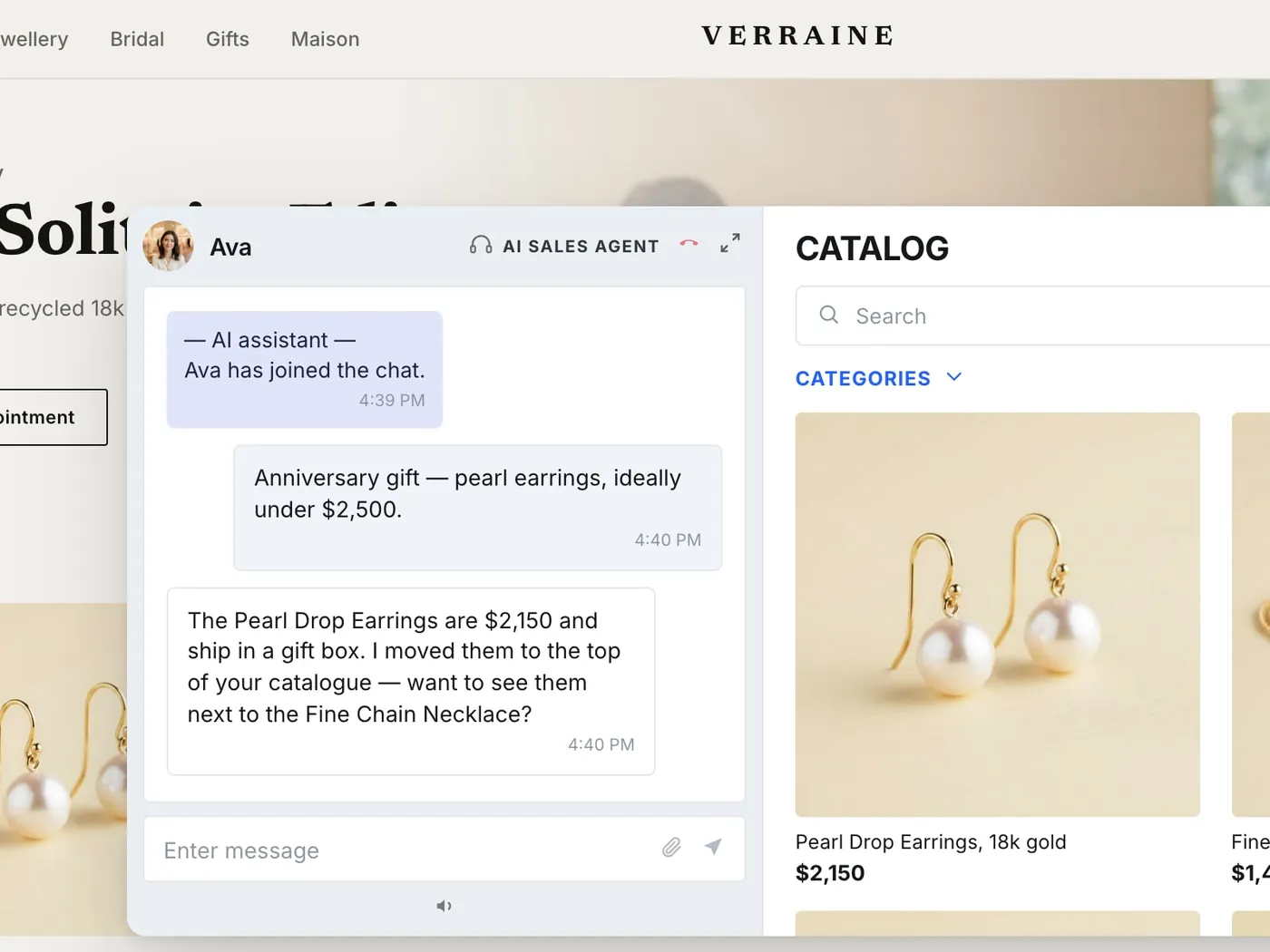
- AI Sales Agent: answers the practical questions (dimensions, materials, delivery) at any hour, so the details the second person asks about that evening have an answer, and hands the conversation to an advisor, with its context intact, when a person is wanted.
- Video Commerce: PDP video and shoppable video show the piece moving and in proportion, which is what a screenshot strips away.
It is the digital equivalent of bring them in on Saturday, without anyone having to travel. The approach stays human, because an advisor shows the piece; personal, because the consultation begins with the piece she has already chosen and the person whose view she values; and measurable, because the house can finally see which considered pieces were decided in company.
Knowing when a client is weighing a piece is its own craft; we wrote about noticing the client circling a piece without watching her.
For a house, the entry point is a conversation and a 60-day pilot, on us.
On the floor, the best advisors have always found a way to include the person who isn’t there.
Online, that person is judging the piece from a screenshot, and nobody has thought to invite them in.
Frequently asked questions
Sometimes exactly what it says: a genuine joint decision about a significant piece, where the client wants the view of a partner, a family member, a friend or a trusted adviser. Sometimes it is a courteous way of leaving without having to say no. Good advisors learn to tell the difference and respect the second kind rather than push against it.
They hold the piece for a few days so the conversation can happen without anxiety; they invite both to come in and see it handled together; they give the client the specific details the other person is likely to ask about; and they anticipate that the second person asks different, more practical questions than the client did.
Because online the second person usually sees the piece as a link or a cropped screenshot on a phone, without its scale, finish or movement, and with nobody to ask. The advisor who would have made the conversation easy on the floor is not part of it at all, so a doubt that would have been answered on a Saturday visit tends to end in a quiet decision to wait.
Three things: consultations with more than one person taking part and their conversion against single-person consultations; share actions on high-value pieces, which show which pieces are most often decided in company; and time from first view to purchase where a joint consultation happened, against where it didn't.