
Best Digital Clienteling Software for Luxury & Jewelry Brands (2026 Comparison)
An honest look at the platforms that help premium brands sell online the way they sell in-store — personally.
The short answer
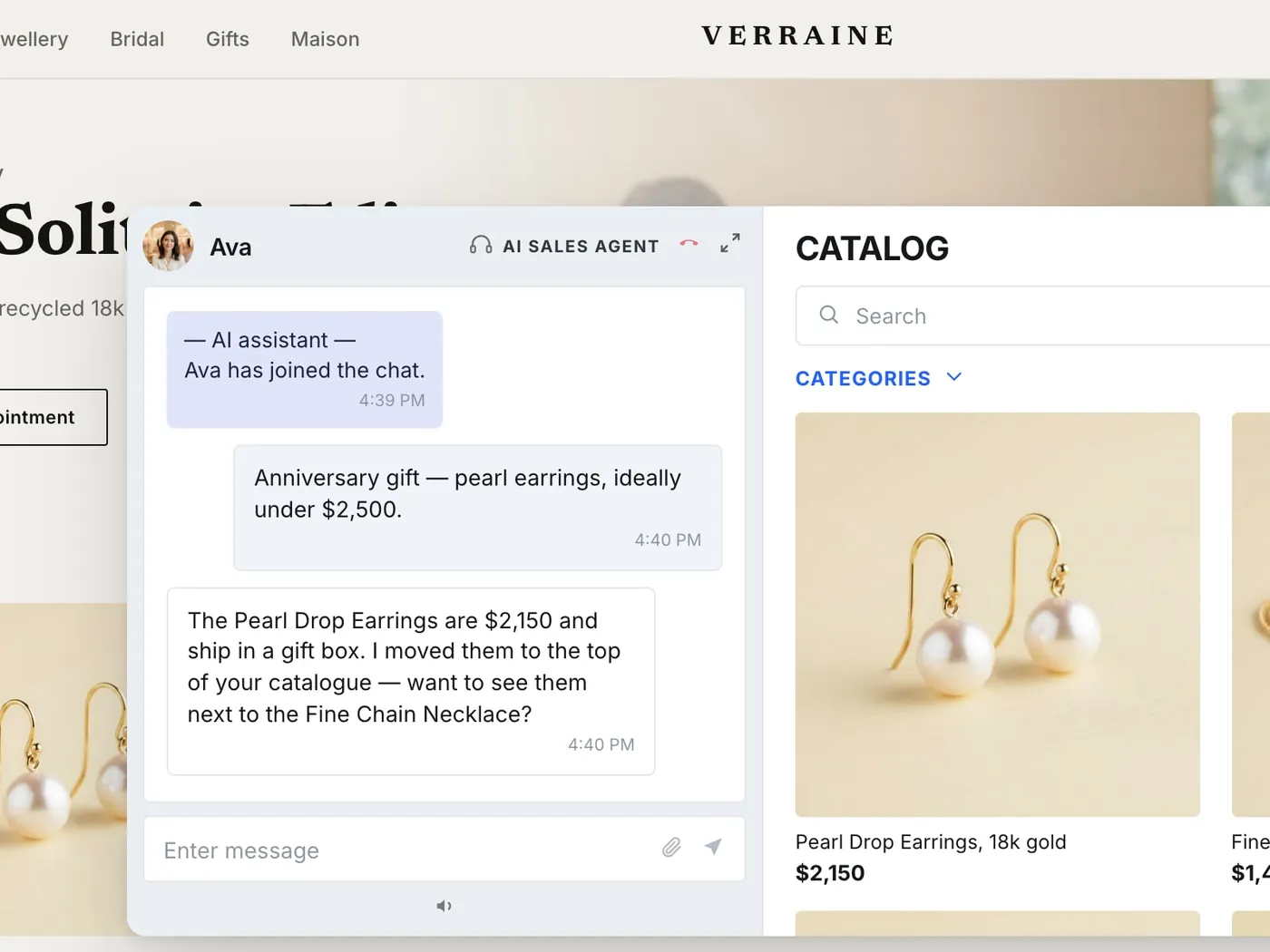
If you sell luxury or jewelry online and want clienteling that closes high-consideration sales — not just stores customer notes — the right choice depends on where your gap is. Endear and Clientbook lead on CRM and SMS/email outreach. BSPK and Proximity lead on equipping luxury store teams around clients they already know. Tulip (now merged with Salesfloor) leads on enterprise in-store associate clienteling at fleet scale. Immerss is the option built for online selling — Live Co-Shopping (real one-to-one video) backed by an AI Sales Agent, so the experience stays Human, Personal, and Measurable.
Almost every platform here is excellent at serving a customer whose name you already have. The question that separates them is what happens with the high-intent stranger browsing your site at 11pm.
Why luxury and jewelry need clienteling in the first place
High-ticket purchases don’t convert on a product grid. A $4,000 ring or a limited-run handbag is a considered, emotional decision — the kind that historically required a knowledgeable associate across a counter. Online, that associate disappears, and conversion collapses with them. The high-intent shoppers who would have bought in person simply leave. The problem was never demand. It was the missing conversation.
Digital clienteling exists to put that conversation back online. But the platforms below take very different approaches to doing it — and the differences matter more than the shared label suggests. This is the same gap we cover in depth in why clicks don’t convert for jewelry.
The honest landscape
Clienteling tools split into four groups, and the label hides how differently they behave:
- CRM / outreach clienteling — unified customer profiles, purchase history, and SMS/email/WhatsApp outreach (Endear, Clientbook). Strong for staying in touch and following up. Clientbook is purpose-built for jewelry retail and integrates natively with jewelry POS systems.
- Luxury associate clienteling — built around a boutique team and its book of VIP clients (BSPK, Proximity). BSPK leans into structured client profiles, WhatsApp and WeChat messaging, and visual curation through Ideabooks, which suits houses with European or APAC clientele. Proximity is closer to a retail super-app: clienteling, mobile POS, appointment booking, and in-store events in one connected app, used by the likes of Max Mara, Paul Smith, Graff Diamonds, and Helzberg. Strong for high-touch selling by named associates.
- Enterprise associate clienteling — built to equip in-store associate fleets across in-store and digital channels, including associate-led video consultations (Tulip, which acquired Salesfloor in a merger announced 24 March 2026, combining under the Tulip brand across roughly 100 enterprise retail clients). Strong for large omnichannel retailers and store networks.
- Online live-selling clienteling — one-to-one live video plus a proactive AI Sales Agent, built to sell to online visitors who will never walk into a store (Immerss).
Most brands need elements of more than one. The real question is which problem is biggest: keeping associates in touch with VIPs, equipping a store fleet, or actually converting the online visitors browsing your site right now.
Notice what groups one, two, and three have in common. They all begin with a relationship that already exists — a client in the book, a customer in the database, an associate who knows the name. That’s the right design for the majority of luxury retail, which is why these platforms are good. It’s also why a brand selling primarily online can buy the best-reviewed clienteling software in the category and still watch its conversion rate sit still: the tool was never pointed at the stranger.
Comparison at a glance
| Platform | Built around | One-to-one live video | How it charges |
|---|---|---|---|
| Immerss | The online visitor — proactive AI Sales Agent, Live Co-Shopping, Video Commerce | ✅ Core (Live Co-Shopping) | Free tier on each module; paid plans banded by monthly traffic — see pricing |
| Endear | Retail CRM and SMS / email / WhatsApp outreach to known customers | ➖ Messaging-first, async video | Per store location, not per seat — published pricing |
| Clientbook | Jewelry-store clienteling and texting, native to jewelry POS | ➖ Video sent over text | Not published — quoted per business |
| BSPK | Luxury boutique teams and a defined book of VIP clients; WhatsApp / WeChat, Ideabooks | ➖ Messaging and curation-first | Not published — quoted per business |
| Proximity | Store teams — clienteling, mobile POS, appointments, and events in one app | ➖ Appointment-led, in-store first | Not published — quoted per business |
| Tulip (incl. Salesfloor) | Enterprise store-associate fleets, in-store and digital | ✅ Associate video consultations | Enterprise, quoted |
This table reflects each tool’s core design focus, not a claim that others lack every feature. Feature sets evolve, the Tulip–Salesfloor merger is recent, and pricing in this category moves — verify current capabilities and numbers on each vendor’s own site before you shortlist.
On the “how it charges” column. It’s there instead of a price list on purpose. A monthly figure is the fastest-rotting fact in this category — plans get renamed, free tiers appear, ceilings move — and quoting one is how comparison articles end up confidently wrong. The charging model is durable and it’s what actually shows up in year two: per location means adding associates is free but adding stores isn’t; per-business quotes mean your cost is a negotiation, not a number you can plan against; traffic bands mean a good month is predictable rather than a surprise line item.
Where each tool wins
- Choose Endear if your priority is structured outreach — keeping associates in touch with VIPs over text, email, and WhatsApp, with clean customer history and AI nudges on who to contact next. It’s an excellent records-and-relationship system.
- Choose Clientbook if you run a jewelry store (or several) and want clienteling tied to jewelry-specific POS systems, with one-to-one and mass texting to follow up on wishlists, trunk shows, and service reminders.
- Choose BSPK if you’re a luxury house or boutique group where a handful of experienced associates each own a book of VIP clients, and the work is remembering, curating, and messaging them well — particularly if that clientele sits in Europe or APAC and lives on WhatsApp and WeChat.
- Choose Proximity if your stores need one app instead of four: clienteling alongside mobile POS, appointment booking, and event management, so the associate isn’t switching tools mid-conversation.
- Choose Tulip (with Salesfloor) if you operate a large store fleet and your main gap is equipping in-store associates with enterprise omnichannel clienteling — associate storefronts, appointment booking, and video consultations across many locations.
- Choose Immerss if your biggest loss is online visitors who would buy with the right conversation — and you want a proactive AI Sales Agent covering every visitor the moment a human can’t, live one-to-one video to close the high-consideration sale, and a Video Commerce layer — without needing a store fleet to make it work.
What about Salesforce, Luxe, and enterprise suites?
The field is wider than the six above. Salesforce offers clienteling through its Service and Commerce Clouds — powerful and deeply customizable, but built for large enterprise retail organizations with the budget and team to run it. Aptos approaches it from unified commerce, giving associates a single view of preferences, purchase history, and repair requests. StyleSend targets high-end fashion and lifestyle retailers. Luxe is another jewelry-focused clienteling and texting tool, sitting in a similar lane to Clientbook for independent jewelers. Several POS vendors now bundle light clienteling features too.
Adding them to the shortlist doesn’t change the core decision — it sharpens it. Every one of these tools answers the question “how do we keep associates connected to customers?” extremely well. The question they’re not built around is “how do we sell to the online visitor who will never speak to one of our associates?” That gap — proactive AI on the storefront plus a live human on video — is the one Immerss is designed to close, and it’s worth being clear about which problem you’re actually solving before you compare feature lists.
How to choose the right clienteling platform
Before comparing features, get clear on the job you’re hiring the software to do. A few honest questions narrow the shortlist fast:
- Where do you actually lose the sale — in follow-up, or on the first visit? If high-intent shoppers leave before anyone reaches them, an outreach CRM won’t fix it; you need something that engages and sells in the moment.
- Are you reaching a known customer or converting an anonymous visitor? Endear, Clientbook, BSPK, and Proximity all shine once a customer is already in the book or the database. Immerss is built to convert the visitor you don’t know yet.
- How does the bill behave when things go well? Ask every vendor what changes when you add a store, add ten associates, or triple your traffic in December. The answers differ more than the feature lists do.
- Is the buying decision visual? Jewelry, watches, and luxury pieces are inspected before they’re bought. If the customer needs to see the item and ask questions live, async texting and email fall short of one-to-one video.
- Do you run stores, or sell primarily online? A large store fleet is the case for Tulip and Salesfloor’s associate tooling; a boutique group with named associates is the case for BSPK or Proximity. A DTC or online-first brand is the case for Immerss.
- How do you want to be measured? Outreach tools report on messages sent and opens; live-selling platforms report on booked sessions and closed sales. Pick the metric that actually moves your business — and make sure the tool keeps it Measurable.
Answer those honestly and the list usually narrows to one or two. That’s the point of an honest comparison: the right tool depends on your gap, not on whoever markets hardest.
Why brands choose Immerss for luxury & jewelry
Immerss brings three integrated modules to high-consideration selling, assembled the way a jewelry or watch brand needs them:
- AI Sales Agent — greets every visitor, answers product questions from your catalog, and guides toward purchase 24/7, then hands off to a human for the moments that matter.
- Clienteling — Live Co-Shopping puts an associate and customer in a one-to-one video session, recreating the in-store white-glove experience online; Outbound handles VIP appointment scheduling and relationship management.
- Video Commerce — Live Shopping Events, a Shoppable Video Library, and PDP videos that let the product be seen, not just pictured.
There are two honest ways in, because there are two different buyers. A smaller merchant can start on the free tier of each module and see the mechanics work before committing to anything. A brand running a real multi-module programme is a conversation instead — scope, catalog, and team don’t fit a self-serve checkout, and a 60-day pilot, on us, is a better test than a trial. Either way the plan is banded by monthly traffic rather than billed per interaction; the current bands are on the pricing page.
The difference is the format: live, face-to-face selling for the online visitor, with autonomous AI coverage underneath it — rather than outreach that depends on a customer you already know, or tools designed around a physical store fleet. It’s the same shift that lets a luxury bootmaker like Lucchese sell five-figure custom orders over live video (see the Lucchese case study) and that we explore in modern clienteling for luxury retailers.
For luxury and jewelry — where one saved sale can pay for the platform many times over — recreating the in-store conversation online is the whole argument. The best way to judge the fit is to see it run against your own catalog: book a demo and the team will map the right combination of AI Sales Agent, Clienteling, and Video Commerce to your brand.
Related reading
Frequently asked questions
Digital clienteling software lets retail associates build personal relationships with customers online — through unified customer profiles, purchase history, outreach, and increasingly live video — to guide high-consideration purchases the way they would in-store. Tools differ in emphasis: some focus on CRM and SMS/email outreach, some on equipping in-store associate teams, and some on selling live to online visitors.
For jewelry, the deciding factor is live visual consultation: customers need to see the piece and ask questions in real time before committing to a high-ticket purchase. Clientbook is purpose-built for jewelry-store clienteling and texting with native jewelry POS integrations; Immerss is built around one-to-one live video selling (Live Co-Shopping) plus an AI Sales Agent on the storefront, which is why jewelers focused on converting online visitors choose it. The right pick depends on whether your gap is in-store follow-up or closing online sales.
Yes, with a different emphasis. Endear and Clientbook excel at CRM and SMS/email outreach — staying in touch with customers and following up. Immerss adds live one-to-one video selling and a proactive AI Sales Agent on your storefront, so it closes online sales rather than only maintaining relationships. Many brands run them for complementary jobs: outreach with Endear or Clientbook, live online selling with Immerss.
Tulip acquired Salesfloor in a merger announced on 24 March 2026, combining the two under the Tulip brand and serving roughly 100 enterprise retail clients. The combined platform is focused on equipping in-store associate fleets across in-store and digital channels, including associate-led video consultations. Immerss is built for selling to online DTC visitors: an autonomous AI Sales Agent engages every visitor 24/7, hands off to one-to-one Live Co-Shopping, and a Video Commerce layer adds live shopping events and shoppable video — without requiring a large store fleet.
Both are credible luxury-focused clienteling platforms and belong on a serious shortlist. BSPK is built for luxury boutiques where a small number of experienced associates manage a defined book of VIP clients, with structured client profiles, WhatsApp and WeChat messaging, and visual product curation through Ideabooks. Proximity is a retail super-app that brings clienteling, mobile POS, appointment booking, and in-store events into one connected app, used by retailers including Max Mara, Paul Smith, Graff Diamonds, and Helzberg. Both are designed around store teams and the clients they already know. Immerss is designed around the online visitor nobody has met yet — which is why brands often run one of these alongside it rather than instead of it.
Yes. Immerss integrates natively with Shopify and Shopify Plus, as well as Salesforce Commerce Cloud, Magento/Adobe Commerce, WooCommerce, and custom platforms via API.
The charging model matters more than the sticker price, because it decides what happens as you grow. Endear publishes its pricing and bills per store location rather than per seat, so adding associates at a location doesn't add cost. Clientbook, BSPK, and Proximity don't publish pricing and quote per business. Tulip (with Salesfloor) and Salesforce are quoted at the enterprise level. Immerss has a free tier on each of its three modules and paid plans banded by monthly traffic, so inside a band the bill is fixed and a busy month moves you up a band deliberately instead of billing you per interaction after the fact. Check each vendor's own pricing page for current numbers — in this category they move.
Yes, though the depth of integration varies. Clientbook connects natively to jewelry-specific POS systems; Endear syncs with Shopify and other commerce data; enterprise suites integrate across large store networks. Immerss layers onto your current stack via native Shopify and Shopify Plus integration, plus Salesforce Commerce Cloud, Magento/Adobe Commerce, WooCommerce, and custom platforms through its API.