
Digital Clienteling: What It Is and How It Works in 2026
A working definition, the mechanics behind it, and how to tell a clienteling programme from a chat widget.
The short definition
Digital clienteling is the practice of building and keeping named, one-to-one customer relationships through digital channels — live video, messaging, appointments, email — on top of a shared client record that any associate can pick up.
It is the boutique client book, moved online and made usable by more than one person’s memory.
Three properties separate it from things it is routinely confused with:
- It is named, not anonymous. A clienteling interaction is with this customer, whose sizes, past purchases and open questions are known before the conversation starts. Marketing automation, by contrast, addresses a segment.
- It is continuous, not ticketed. Support closes a case. Clienteling assumes the next conversation and prepares for it.
- It is sales-led, not service-led. The associate’s job is to help someone decide — not to resolve a complaint.
“Virtual clienteling” and “digital clienteling” mean the same thing in ordinary use. The first tends to emphasise the live remote channel; the second covers the whole programme.
Where the practice comes from
Clienteling emerged from luxury retail’s recognition that personal relationships drive business results. A boutique associate greets a customer by name, remembers what they wore last season, and recommends from genuine understanding of their taste. Customers respond to it — the shopping stops feeling like a transaction.
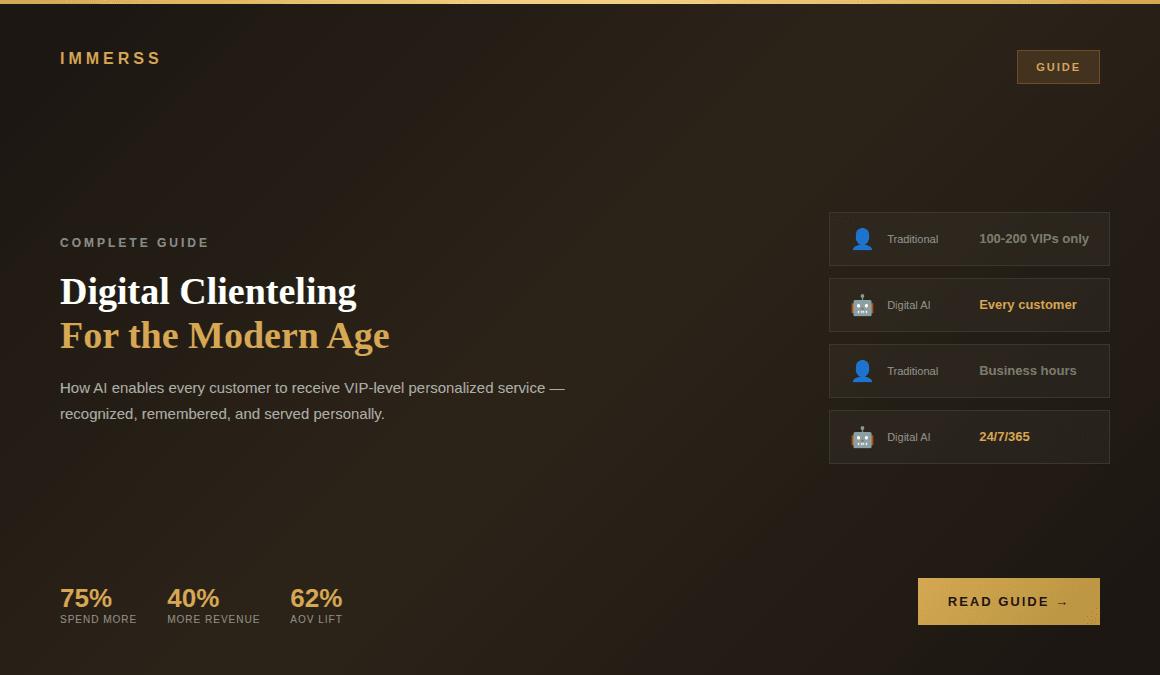
The method had one hard limit: a skilled associate can hold real relationships with perhaps a hundred or two hundred customers. That is the ceiling of attention and memory, and note cards in a drawer did not raise it.
So retailers rationed the practice. A small tier of high-value clients received personal service, remembered preferences and proactive outreach. Everyone else got a generic experience that started from zero on every visit.
That two-tier arrangement made arithmetic sense when the top tier generated the revenue. It reads differently to a customer who is used to being recognised by every other service they touch.
Digital vs. manual clienteling
The distinction is not “with software” versus “without software”. It is about what survives the shift ending.
| Manual clienteling | Digital clienteling | |
|---|---|---|
| Where the record lives | An associate’s notebook, phone contacts, memory | Shared system any associate can open |
| Who can serve the client | The one associate who knows them | Anyone on the team, with full context |
| Reach | Whoever walks into the store | Online visitors, remote customers, other cities |
| Channel | In person, personal phone, personal text | Live video, SMS, email, booked appointments |
| What happens when they leave | The book leaves with them | The book stays with the brand |
| Measurement | Anecdote | Assisted orders, reply rates, repeat rate |
The last two rows are why finance departments end up caring about a practice that sounds soft. A client book held in one person’s phone is an asset the brand does not own and cannot audit.
What a digital clienteling programme actually contains
Vendors describe wildly different products with the same word. In practice a working programme has six parts, and a tool usually covers three or four of them.
1. A unified client record. Purchase history, sizes and fit notes, stated preferences, wishlist, past conversations, service history — aggregated from the storefront, the POS and the inbox rather than retyped. Fragmented data caps how personal the next conversation can be; this is the part that has to exist first.
2. A live human channel. One-to-one video co-shopping, where an associate and a customer are in the same session, looking at the same product, with cart and checkout available inside the call. This is the part that replaces the showroom conversation rather than approximating it in text — the customer sees the grain of the leather, the setting of the stone, the actual scale of the piece against a hand.
3. Outbound with a reason. A new collection that matches a stated preference, a restock in their size, a service reminder two years after a watch purchase, an invitation to book an appointment. The discipline is that outreach references something true about that specific customer; a broadcast with a first name in it is not clienteling.
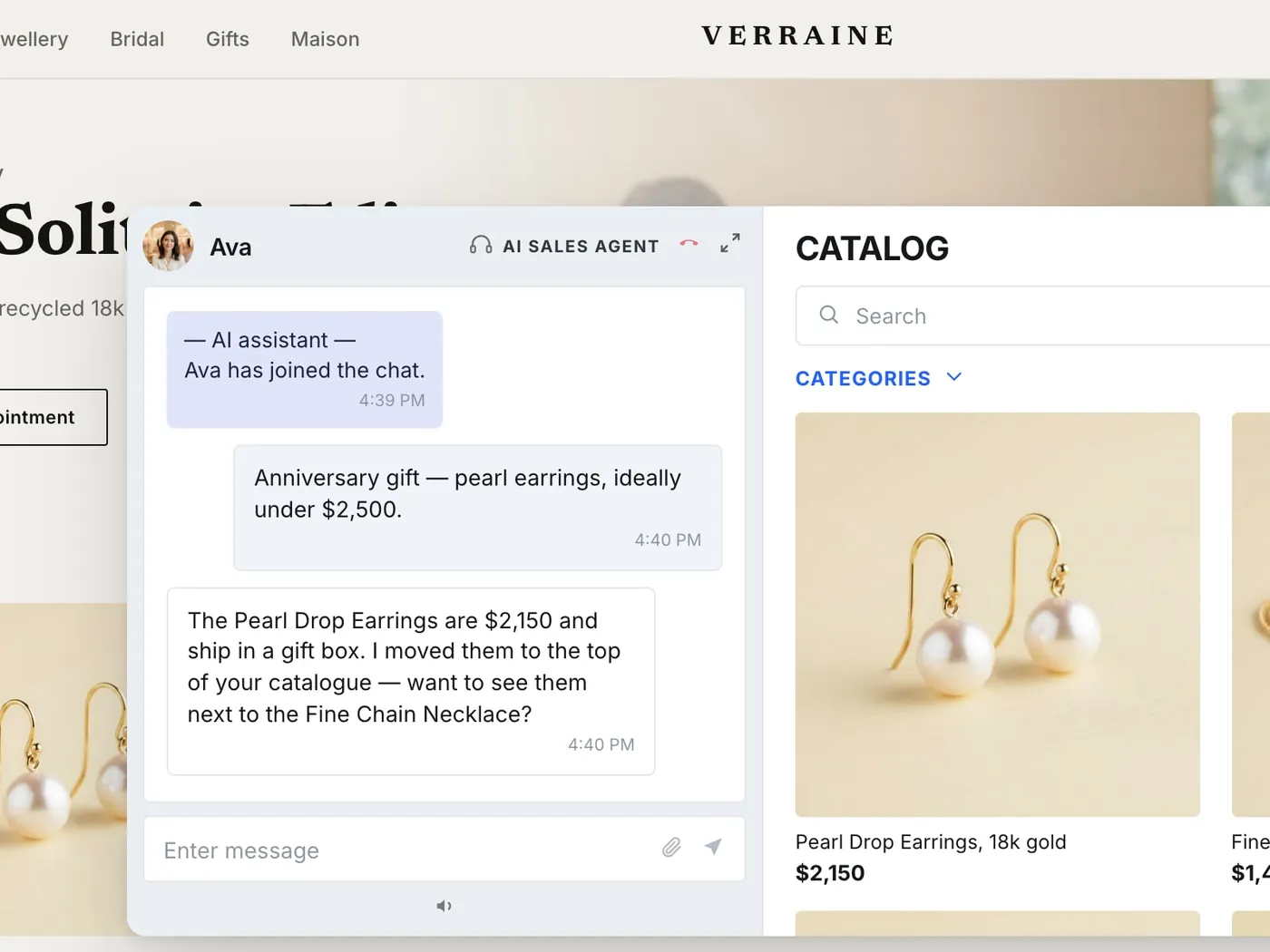
4. Always-on coverage underneath. Associates are not available at 3 a.m., and most storefront traffic arrives without an appointment. An AI sales agent answers product questions from the catalogue around the clock, qualifies who is worth a human’s time, and hands off with the context intact so the customer never repeats themselves.
5. Video that outlives the session. A live shopping event, a shoppable video library, PDP video. The same expertise that convinces one person in a call convinces the next hundred asynchronously.
6. Instrumentation. Assisted versus unassisted orders, reply rates, appointment show rates, repeat purchase rate by associate. Without it the programme is a collection of nice interactions and no argument for its own budget.
The store associate becomes the channel
The most under-used asset in this whole category is a person who already knows the product and already sells it well — and who, in most retailers, still waits for someone to walk through a door.
Retailers connected online inventory to physical locations and handed associates tablets, so an item out of stock in one store can be ordered for delivery from another. The next step is the interesting one: putting those associates in front of e-commerce customers directly, so a shopper can ask a person — not a chatbot — about an item’s look, feel and fit.
“You actually do feel like you’re in a store, besides the touch and feeling of everything. Everything else is there and, more importantly, the fact that you’re actually talking to a sales associate, not to a call center employee — that makes a huge difference.”
— Arthur Veytsman, co-founder and CEO, Immerss
Two consequences follow. Associates stop depending on foot traffic and can reach online shoppers deliberately, which matters a great deal to anyone working on commission. And the work becomes location-independent: a team that can sell over live video can keep selling through a snowstorm, a transport strike or a lockdown.
The category has been consolidating around this logic for years. Neiman Marcus Group partnered with the machine-learning platform Stylyze in 2018, made it a component of its CONNECT remote-selling and clienteling system, and announced its intent to acquire the company outright in June 2021 — framing it as part of a planned investment programme of over half a billion dollars. Clienteling technology stopped being a nice-to-have line item and became infrastructure that large retailers would rather own.
It is worth being honest about the cost side: these are new duties layered onto associates who are also fulfilling online orders and handling curbside pickup. A clienteling programme that ignores scheduling and workload arrives as one more app nobody opens.
Where it pays — and where it doesn’t
Digital clienteling earns its keep where a purchase involves genuine deliberation and the answer to one question decides the sale:
- Jewelry, watches and bridal — where authenticity, provenance and how a piece actually sits on a wrist are unanswerable from photographs.
- Custom and high-fit categories — bootmaking, tailoring, eyewear, where the decision is about your body, not the product in the abstract.
- Furniture and interiors — scale, finish and material against a room the customer is standing in.
- Premium apparel and accessories — cut, drape, and what goes with what.
Lucchese, a bootmaker in business since the nineteenth century, is the clean example: a company whose staff were superb in person and whose website reduced that expertise to a chat box. Adding live video put those same associates in front of online buyers configuring five-figure custom orders — the full story is in the Lucchese clienteling case study.
Where it does not pay: low-ticket, habitual repurchases. If the customer already knows exactly what they want and the order is small, a named human relationship costs more than it returns. Coverage from an AI sales agent is the right level of investment there.
Measuring it
The reason clienteling programmes get cut is that nobody instrumented them, so the first budget review finds only anecdotes. Decide what you are counting before rollout:
- Assisted vs. unassisted orders — the share of revenue that passed through a clienteling interaction, and how those orders differ in size and composition.
- Return rate on assisted orders — the single most convincing number in fit-driven categories, because a conversation before purchase is the cheapest returns intervention there is.
- Repeat rate by client book — are named clients coming back more often than the anonymous baseline?
- Outbound response rate — the honest test of whether your outreach references something real about the customer.
- Appointment show rate and time-to-first-response — the operational health of the programme.
- Associate-level reporting — which associates convert, so the practice can be taught rather than admired.
Report these against your own pre-programme baseline. Industry averages tell you nothing about your catalogue, and vendor benchmarks are marketing.
Rolling it out
Phase 1 — foundation. Unify the client record across storefront, POS and inbox. Train associates on selling over video, which is a different skill from selling in person: framing, lighting, narration, and knowing when to stop talking. Define who qualifies for an appointment and who gets self-serve coverage. Stand up the reporting.
Phase 2 — narrow launch. One category or one client segment. Watch reply rates and session outcomes weekly, adjust staffing to the demand pattern you actually observe, and fix the scheduling friction before scaling it.
Phase 3 — expansion. Extend to more categories, add asynchronous video so the expertise compounds, and connect clienteling data to merchandising and buying — knowing what clients ask for before it shows up in sales data is worth more than the incremental orders.
Where Immerss fits
Immerss is a live commerce platform, and clienteling is one of three modules that work together:
- Clienteling — Live Co-Shopping puts an associate and customer in a one-to-one video session with the catalogue and checkout inside it; Outbound handles appointment scheduling and ongoing client relationships.
- AI Sales Agent — answers product questions from your catalogue 24/7, qualifies intent, and escalates to a human with full context.
- Video Commerce — Live Shopping Events, a shoppable video library and PDP video, so one expert conversation keeps selling after it ends.
The through-line is that the service stays human, the interaction is genuinely personal because it starts from a real record of that customer, and the result is measurable at the order level rather than inferred.
There are two honest ways to begin, because two different kinds of retailer read this page. A smaller merchant can start on the free tier of each module and see the mechanics work first-hand. A brand running a multi-module programme across a store fleet is a conversation instead — scope, catalogue and team don’t fit a self-serve checkout, and a 60-day pilot, on us, is a better test than any demo environment. Plans are banded by monthly traffic rather than billed per interaction; the current bands are on the pricing page.
If you want to see it against your own catalogue: book a demo.
Choosing a platform
Tools in this category are built around different assumptions — some around a physical store fleet, some around SMS and messaging, some around live selling to online visitors — and the assumption matters more than the feature list. Our comparison of the best digital clienteling software for luxury and jewelry brands breaks down how each one charges and which retailer each is actually designed for.
Related reading
Frequently asked questions
Digital clienteling is the practice of building and keeping named, one-to-one customer relationships through digital channels — live video, messaging, appointments, email — on top of a shared client record that any associate can pick up. It moves the boutique client book online and makes it usable by a whole team rather than one person's memory.
Manual clienteling lives in an individual associate's notes and memory, works only when that associate is on shift and in the store, and leaves with them when they go. Digital clienteling keeps the same record in shared software, so outreach continues across channels and shifts, remote customers are reachable, and the activity can actually be measured.
In practice, yes — the terms are used interchangeably. 'Virtual clienteling' tends to emphasise the live remote channel (one-to-one video consultations with an associate), while 'digital clienteling' covers the whole programme: the client record, outbound outreach, appointments and the live sessions themselves.
It consolidates the client record (purchases, sizes, preferences, past conversations), gives associates a channel to reach those clients — video, SMS, email, appointment booking — and reports on what the outreach produced. Platforms differ mainly in whether they are built around a physical store fleet, around messaging, or around live selling to online visitors.
Clienteling is normally added to the storefront rather than built into it. Tools integrate with Shopify, Salesforce Commerce Cloud, BigCommerce, WooCommerce and Magento through apps, scripts or APIs, reading catalogue and order data so associates see the same products and history the customer sees.
No, but it pays where consideration is high — jewelry, watches, bridal, furniture, custom footwear, premium apparel — because a single saved or upsold order covers a lot of programme cost. For low-ticket, habitual repurchases the economics rarely justify a named human relationship.