
Conversational Commerce Platforms: How to Choose in 2026
What the category actually contains, how the vendors in it charge, and the questions that decide which one fits your brand.
Executive Summary
“Conversational commerce platform” is a label, not a product category. Search it and you’ll get review directories listing dozens of vendors side by side: support helpdesks, messaging infrastructure, personalization suites, and live selling tools, all filed under one heading as if they were interchangeable.
They are not. A helpdesk that resolves where is my order and a platform that puts a specialist on video with a customer choosing between two handbags are both “conversational commerce.” They are built for different jobs, they succeed by different measures, and — the part that decides most contracts — they charge on different axes.
This page is a comparison, not a definition. It sorts the category into the four types of product actually sold in it, sets out how each type prices, and gives you the questions that separate them. If you’re building a shortlist, the sections on categories and pricing models are the ones that will save you a quarter.
What conversational commerce covers — and what it doesn’t
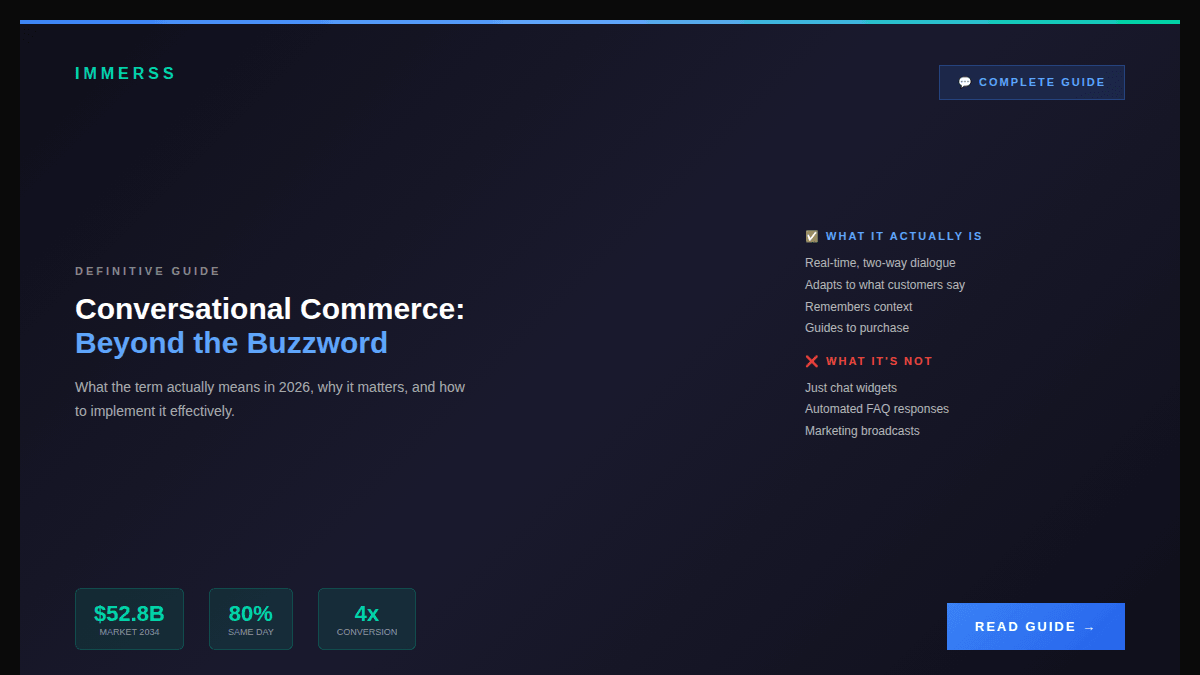
Conversational commerce means using real-time, two-way conversation as a primary sales and support channel: chat, AI agents, messaging apps, voice, live video — any channel where a brand and a shopper exchange messages.
The load-bearing word is exchange. Traditional e-commerce presents information and waits for a click. Conversational commerce responds to what a specific customer said, remembers what came before it, and handles the question that wasn’t anticipated.
That definition rules a lot of things out, which is useful when a vendor demo starts:
- A FAQ page isn’t conversational commerce. It presents; it doesn’t respond.
- A script-following bot isn’t either. If it only recognises expected phrasings and dead-ends on everything else, it’s a menu with a text box.
- Messaging campaigns aren’t. Promotional sends through WhatsApp or SMS are broadcast, not dialogue — the direction of travel is one-way.
- AI for its own sake isn’t. An impressive model that doesn’t move a customer closer to a decision is a technology demonstration.
Hold vendors to the exchange test and the shortlist gets shorter quickly.
The four categories hiding behind one label
1. Helpdesk-first platforms
Examples: Gorgias, Tidio, Ada.
Built for support. Their native unit of work is a ticket or a resolved conversation, and their historical job is deflection — answering the predictable question without a human touching it. Most have added product recommendations and cart nudges, and some do it well, but the architecture reflects the original job: queues, macros, resolution rates.
Good fit when your conversation volume is dominated by post-purchase questions, your catalogue is simple enough that recommendation is a lookup, and the win you need is cost per contact.
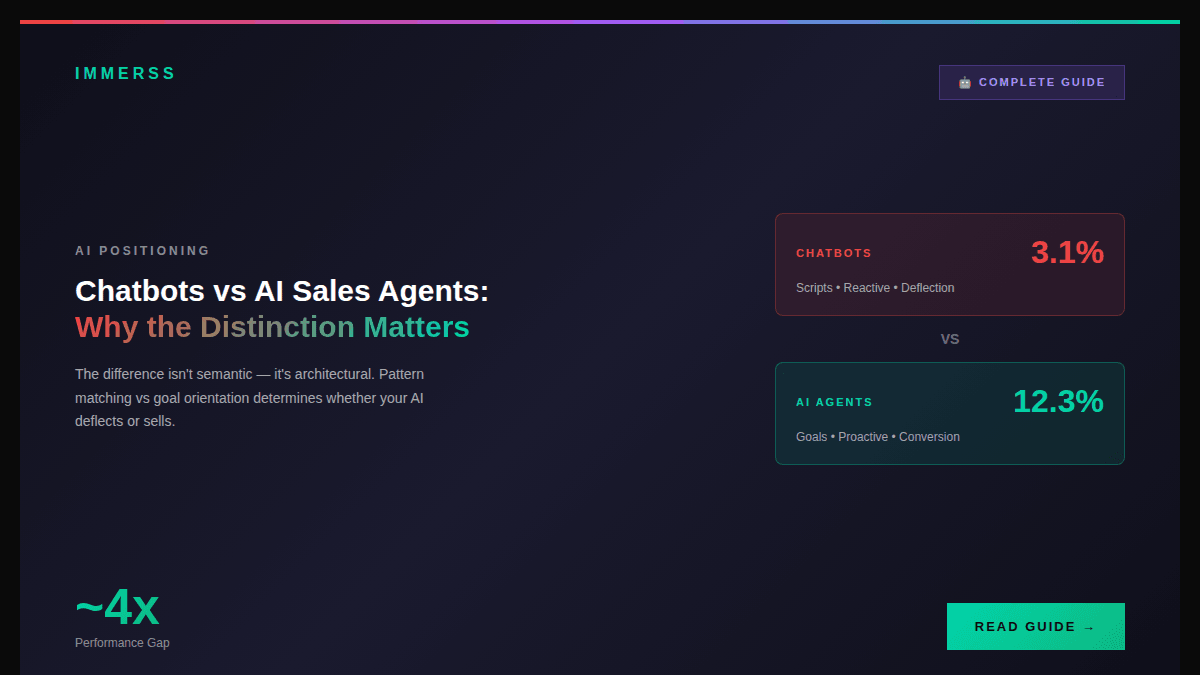
Poor fit when the conversation is the sale. Deflection and selling pull in opposite directions: one optimises for ending the conversation, the other for deepening it. We’ve written about that split in detail in chatbot vs AI sales agent.
2. Messaging infrastructure
Examples: LivePerson, ManyChat, the WhatsApp Business ecosystem.
These sell reach and plumbing: connections to messaging channels, routing, compliance, throughput. They are how a brand gets a presence inside apps customers already use, at volume.
Good fit when channel coverage is the constraint — you need to be in WhatsApp, Messenger, SMS and RCS with one system behind them, and you have the team to design what gets said.
Poor fit when you expected the platform to know your catalogue and sell from it. Infrastructure gives you the pipe; the selling logic is yours to build.
3. Personalization and journey suites
Examples: Bloomreach, Salesforce, Insider.
Here conversation is one surface inside a larger orchestration stack — search, recommendations, lifecycle messaging, segmentation. The conversational module inherits the suite’s data, which is genuinely powerful, and the suite’s weight, which is genuinely heavy.
Good fit when you already run commerce or CRM on that platform. The integration you’d otherwise pay for in a services contract comes as standard.
Poor fit when you don’t. Buying a suite to get its chat module means adopting an implementation programme, not a tool.
4. Live and human-assisted commerce
Examples: Immerss, and the live selling and clienteling category around it.
The unit of work is a considered purchase, assisted. An AI agent handles discovery and objections at scale; a person is available for the conversations that warrant one — 1:1 video, a co-shopping session, an outbound note from the associate who sold to that customer last season.
Good fit when average order value is high enough that a human minute pays for itself, the product needs demonstrating, or the customer is choosing between options rather than looking for a known item.
Poor fit when your volume is low-value and high-frequency. Assisted selling on a small replenishment order is a cost, not an advantage.
The categories side by side
| Built for | Unit of work | Typically charged by | Strongest when | |
|---|---|---|---|---|
| Helpdesk-first | Support, deflection | Ticket / resolved conversation | Ticket allowances with overage; per AI resolution | Post-purchase volume dominates |
| Messaging infrastructure | Channel reach | Message / session | Volume tiers, per channel, enterprise contract | Coverage is the constraint |
| Personalization suites | Journey orchestration | Campaign / experience | Annual platform contract, quoted | Already on the suite |
| Live & human-assisted | Assisted selling | Considered purchase | Traffic bands per module | High AOV, product needs showing |
A shortlist that spans three of these rows isn’t a shortlist. It’s a sign the requirement hasn’t been written yet.
How these platforms charge — the axis that decides the bill
Pricing pages change; pricing models rarely do. The model is what you should compare, because it determines what happens to your bill in the specific scenario you’re buying for: success.
Per resolved conversation or per ticket. The helpdesk model. Plans carry a monthly allowance of billable tickets, with a per-ticket charge once you pass it, and AI resolutions often billed separately on top — Gorgias, for instance, charges an allowance-plus-overage for tickets and a per-resolution fee for its AI agent, and notably does not charge per seat, which matters if you staff many part-time associates. Check the current numbers on Gorgias’s pricing page.
Per AI conversation, as a separate quota. Tidio’s Lyro bills AI conversations against their own allowance, distinct from billable human conversations and from automation triggers — three quotas running in parallel, each with its own ceiling. A simple question and a ten-turn troubleshooting thread consume the same unit. Current tiers are on Tidio’s pricing page.
Per seat. The classic helpdesk axis, still common. It prices your team, not your customers, which is predictable — until seasonal staffing arrives.
Annual platform contract, quoted. LivePerson, Salesforce, Bloomreach. The number comes from a sales process and bundles modules you may or may not use. Predictable once signed, opaque before.
Traffic bands. How Immerss prices: plans are banded by monthly site traffic, per module, and each of the three modules has a free tier. See our pricing for where your traffic lands.
Why the axis matters more than the number
Take the per-conversation models seriously for a moment. Under them, the bill is a function of how much the thing works. A campaign lands, conversations spike, and the invoice follows — you are billed after the fact for your own good quarter. That isn’t a scandal, it’s just an incentive worth seeing clearly before you sign: it puts a small tax on every conversation you might have started.
Traffic bands move the variable somewhere less perverse. Inside a band, having more conversations doesn’t change what you pay; you move up a band when your traffic grows, which is a deliberate step you can see coming rather than an overage line you discover. We should be straight about the limits of that: the free tiers are real but capped — the streaming module’s free tier covers one event and a few hundred views — so a serious programme is a paid one. The honest claim isn’t “cheaper.” It’s bands versus per-view overage: a fixed bill inside a band, and a deliberate step between them.
One rule holds across every vendor in this category, including us: don’t compare monthly figures, compare axes. Two numbers from two different models aren’t a comparison; they’re answers to two different questions.
Seven questions that decide the fit
Run every vendor on your shortlist through these. They separate the categories faster than a feature matrix.
- Is the job deflection or selling? Ask what the platform’s own dashboard puts at the top. Resolution rate and first-contact resolution mean it was built to end conversations. Assisted revenue and attributed orders mean it was built to start them.
- What happens when the AI reaches its limit? Every system has one. The question is whether the handoff goes to a queue, to a form, or to a named person who can see the whole conversation — and how long the customer waits.
- Does average order value justify a human minute? This single number decides between category 1 and category 4 more reliably than any demo. High-consideration purchases repay attention; replenishment doesn’t.
- Which channels do your customers actually use? Not which channels are available. Presence where customers already are beats omnichannel coverage for its own sake — better one channel done exceptionally than four done thinly.
- How does the bill move when it works? See above. Model the good quarter, not the average one.
- What does it integrate with, and how deeply? Live catalogue, inventory, order history, CRM. A conversational agent that can’t see stock will confidently sell what you don’t have.
- Can you attribute revenue to conversations? If the platform can’t tell you which orders followed an assisted conversation, you cannot manage the programme — you can only believe in it. Measurable is not an optional property.
For the discovery-and-recommendation end of this, our comparison of AI shopping assistants and guided selling tools covers the vendors that specialise in it.
The channels, briefly
Whatever category you buy from, these are the surfaces it will run on.
Messaging apps. WhatsApp, Messenger, WeChat — where customers already talk to everyone else in their life. The advantage is ambient presence: no site visit, no app download, and a conversation that can resume days later without losing context.
On-site chat. The advantage here is context. The system knows what’s been viewed, what’s in the cart, and where the customer is in the process, which makes proactive engagement possible rather than presumptuous.
Social DMs. Discovery happens on social; the question that follows arrives as a DM. That thread can carry a customer from curiosity to purchase without leaving the app.
Voice. Still early, mostly reorders and status checks. It’s the most natural conversational interface and the least mature commerce channel; treat it as a roadmap question, not a selection criterion.
RCS. Rich messaging in the native phone inbox — images, carousels, and action buttons inside a text thread. Since Apple’s adoption of RCS, enterprise traffic has grown sharply, and it brings interactive capability to the most universal channel there is without asking anyone to install anything.
Three distinctions people get wrong
Conversational commerce vs social commerce. Social commerce is about selling through a platform’s native features — shoppable posts, in-app checkout, livestream tools. Conversational commerce is about the dialogue, wherever it happens. They overlap constantly: discover on Instagram, ask in the DM, buy in the thread. Strategy differs though — social commerce work is content and platform features; conversational commerce work is dialogue design and AI capability.
Conversational commerce vs chatbots. Chatbots are a technology; conversational commerce is a strategy. A rule-based bot deployed for deflection is a chatbot and not conversational commerce. A human associate selling through a messaging thread is conversational commerce and not a chatbot.
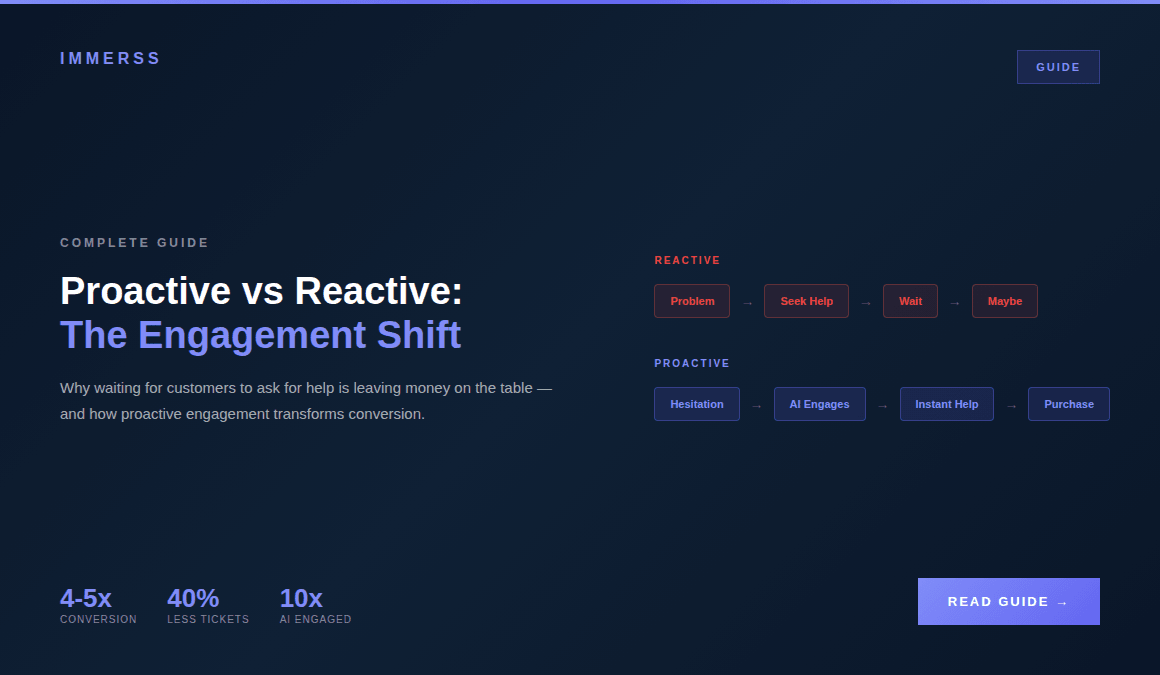
Conversational commerce vs customer service chat. Service chat is reactive and organised around problems. Conversational commerce is engaged across the whole journey — discovery, consideration, purchase, and after it. Many deployments do both through one interface, but the strategic emphasis differs, and that emphasis is what you’re buying.
Implementation: the order that works
The sequence matters more than the tooling. Brands that get this wrong usually bought first and specified afterwards.
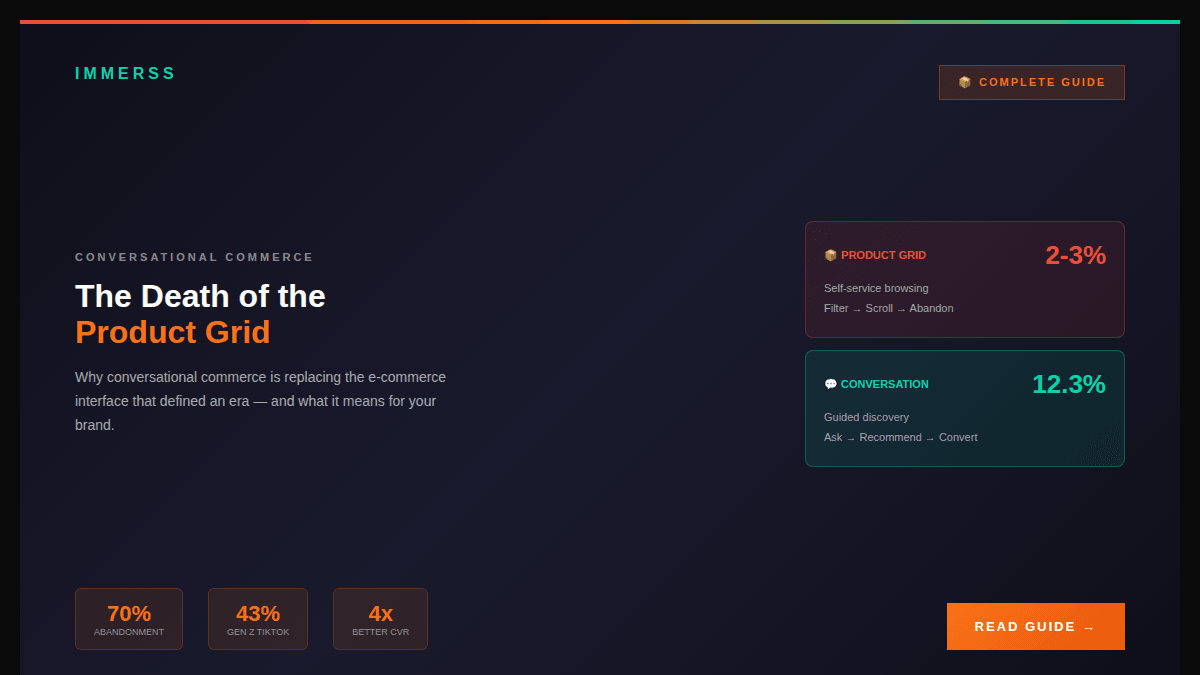
1. Audit what customers actually ask. Read support transcripts, on-site search queries, and the abandonment points. Roughly seven in ten carts are abandoned, and a share of that is unanswered questions rather than price — the questions people ask before buying are the specification for a conversational programme.
2. Prioritise channels narrowly. Pick where your customers already are. Expand after one channel works.
3. Design the conversation before the technology. Map the common path from first message to purchase, then map the escalations. Plan for the ordinary case and the exception separately — and give the AI a personality consistent with the brand, because it will be the brand for most people who meet it.
4. Then select the platform, against the seven questions above rather than a feature list.
5. Design the hybrid model deliberately. Decide what AI owns, what people own, and how a conversation moves between them without the customer repeating themselves. Start with narrow AI scope done reliably; widen it as it earns trust. And train the human side for its new shape — when AI absorbs the routine, every human conversation left is a hard one.
6. Deploy small, then read the transcripts. Not the dashboard — the transcripts. They’re where you find the questions nobody anticipated and the places the conversation dies.
Where Immerss fits
Immerss is a live commerce platform rather than a single tool, and it sits squarely in the fourth category: assisted selling for brands whose products reward attention. Three modules, used together or separately:
- AI Sales Agent — engages browsing customers, understands need through dialogue, recommends, handles objections, and carries the conversation toward a decision. Built for selling rather than deflection, which is a different optimisation target from the first hour of the project onward.
- Clienteling — 1:1 live co-shopping, where a customer and an associate see the same products together, plus outbound: the associate who knows a client reaching out when there’s a reason to.
- Video Commerce — live shopping events, shoppable video, and video on the product page, so the demonstration lives where the decision is made.
The through-line is human, personal, measurable. Human, because at high consideration the person on the other end is the product — AI carries scale, people carry the conversations that turn on trust. Personal, because a co-shopping session with a client’s history in view is not a segment of one, it’s an actual relationship. Measurable, because assisted conversations tie to orders; a programme you can’t attribute is a programme you can’t run.
Brands like Lucchese use it for the fit-and-craft conversations that decide a boot purchase, and Hammitt for live and 1:1 selling around a considered handbag — both cases where the choice isn’t about finding a product but about being sure of one.
Our own entry point is a conversation rather than a signup form, and for a real programme we run a 60-day pilot, on us — long enough to see assisted conversations against your own catalogue and traffic instead of a demo dataset. Book a demo if you want to see it against your store.
Running the shortlist
If you take one thing from this page: decide which of the four categories you’re buying from before you compare vendors inside it. Most bad conversational commerce purchases aren’t bad products, they’re a category mismatch — a deflection tool bought to grow revenue, or a suite bought for a module.
Then compare on axes that survive contact with a good quarter: what the platform is built to do, what happens when the AI stops, how deep the catalogue integration goes, and how the bill behaves when the programme works. Pricing pages will have changed by the time you read this. The models won’t have.
For where your own engagement numbers sit against the market before you start, our e-commerce benchmarks give the baselines. For the broader case for assisted selling over self-service browsing, start with the guide to AI sales agents.
Running a smaller store and want to see the self-serve side of live commerce? landing.immerss.live. Agencies and technology partners: partners.immerss.live.